by Rick Price
Mia Birk’s book Joyride: Pedaling toward a Healthier Planet, is a “how-to manual” for creating a first class bicycle community. Anyone in government or anyone interested in bicycle advocacy would benefit from reading Birk as a way to put their community on the right track to becoming bicycle friendly.
Birk recounts a perfect storm of events when she became Bicycle Coordinator in Portland in 1993. The US Congress had just funded the first six-year federal transportation package that included a small allocation for “Transportation Enhancements.” “Enhancements” were meant to fund transit, bicycling and walking facilities as Congress attempted to counter the “roads only” policies of state departments of transportation. This enabled states and cities like Fort Collins, Boulder in Colorado and Corvallis, Eugene, and Portland, Oregon to write bicycle plans and to hire bicycle coordinators.
In Portland in 1990 the Bicycle Transportation Alliance (BTA) had been founded, and was to become one of the most active advocacy groups in the nation. Earl Blumenauer, now Congressman from Oregon’s 3rd Congressional District and founder of the Congressional Bike Caucus, was Portland’s Commissioner of Public Utilities. With Blumenauer’s support and with the backing of the BTA Birk set out to make Portland, a city of 500,000 people, a friendlier place to ride a bicycle.
As she explains in Joyride Birk had a series of revelations during the first years of her job that opened her eyes to the challenges she faced. Despite enjoying great support in the bicycle community, she noted that “if I spend my time preachin’ to the gospel choir, the bicycle revolution isn’t going to spread very far.” Additionally, when Portland’s traffic engineers suggested that rather than stripe bicycle lanes, they get the police to enforce the law to encourage more cyclists, she noted “the police won’t even talk to me [as bicycle coordinator] let alone” enforce the rules of the road to protect cyclists.
Another revelation came after her third annual bike to work day when Birk asked herself, “is this helping to get more people out riding? Is my time best spent running events like this, or working on bikeway projects?” The answer, she found, was that she needed to mobilize the non-bicyclists in town, build bike paths and lanes, and to become more of a catalyst in bringing people together to change the culture in order to get reluctant cyclists on their bikes. “It’s not enough to adopt a Bicycle Plan” she wrote, “we’ve got to retrain all the humans involved, both inside and outside government.”
So Birk began with neighborhood meetings at Denny’s. Then she met with the Lions Club. Once she was fully underway she was meeting with “business groups, ethnic groups, neighborhood associations, school groups, churches” and as she explains it, “pretty much anyone who” would listen in a series of sixty meetings across Portland.
The results of Birk’s work are impressive to the degree that Joyride should be required reading for anyone who wants to see bicycle ridership increase in their community.
Showing posts with label Portland. Show all posts
Showing posts with label Portland. Show all posts
Wednesday, June 29, 2011


Saturday, November 13, 2010
Portland Pushes the Envelope for Bicycling: Bike Boulevards Become Greenways
This is a great new video from Streetfilms.org by Clarence Eckerson, Jr. that says everything about how, if we can't create separated bikeways or cycle tracks, let's make friendly bicycle streets or "greenways," out of our neighborhood streets so bicyclists, pedestrians, skaters, skate boarders, and everyone else can enjoy them without the automobile dominating everything. That is what Portland is doing as a part of their campaign to achieve 25% bicycle trips. Simple traffic calming techniques, like speed bumps, and even simpler ideas like "changing the orientation of nineteen stop signs" on NE Going St. in Portland to facilitate the flow of bicycles seems like a no-brainer. Surely we can do things like this in Fort Collins.
Portland's Bike Boulevards Become Neighborhood Greenways from Streetfilms on Vimeo.
Portland's Bike Boulevards Become Neighborhood Greenways from Streetfilms on Vimeo.
Tuesday, August 25, 2009
Pedaling Revolution: How Cyclists are Changing American Cities
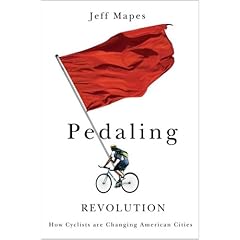
A Book Review by Rick Price, Ph.D.
(by Jeff Mapes, Oregon State University Press, 2009)
The author of Pedaling Revolution, Jeff Mapes, covers politics for the Portland Oregonian;, he is a blogger, a bicycle commuter, and by virtue of having spent nights and weekends from 2004 until April of 2008 thinking about and writing this book, he has become a bicycle advocate. Put him on your list of people to invite to your bike summit or alternative energy fair as recently Mapes was the keynote speaker at such disparate events as the
 energy - SolWestFair - in John Day, Oregon and the Miami Valley Cyclists’ Summit in Dayton, Ohio. (Oh yeah, did I mention, that Mapes’ family just purchased a cargo bike with the capacity to haul 400 lbs of cargo? Now that’s the sign of a committed bicycle advocate.)
So what makes Pedaling Revolution a great book? And what makes Jeff Mapes the latest candidate as spokesperson for our very own bicycle “revolution”? Stories, that’s what, the stock-in-trade of the “literary journalist.”
Mapes is no John McPhee or Tracy Kidder just yet, but he has pulled together a great collection of interviews, stories, and accounts of personal encounters with the people who have made this revolution. And in so doing he reminds us of the value of personal passion, local advocacy, and the role that we all might aspire to play in the revolution. I especially like the nuggets of history and advocacy that he has dredged up in his quest to understand the resurgence of the bicycle in this country.
Take Davis, CA, for example. Why is Davis, widely known as “bike town USA,” head and shoulders above the rest of us for its bike culture? In part, explains Mapes, because of the seeds sown by Davis’s University Chancellor Emil Mrak in the early 1960s. Mrak loved to bicycle and when he became Chancellor he asked his planners and architects to “plan for a bicycle-riding, tree-lined campus.” Then he banned motor vehicles from the central part of campus. The rest is history.
There are other hints of how one person can effect change and help sow the seeds of a bicycle revolution. For example, where did all those bike paths in our bicycle friendly cities come from anyway? Well, you may remember New York Senator Daniel Patrick Moynihan. He was a sociology professor and as a young academic Moynihan wrote an article in 1960 called “New Roads and Urban Chaos,” in which he predicted that urban chaos will break out if States were allowed to build the Interstate Highway system with unrestricted funding from the federal government.
Thirty years later, as chair of the Senate Environment and Public Works subcommittee, Moynihan created local metropolitan planning organizations designed to provide a check and balance on every state’s “roads only” Department of Transportation ( you know, the DOTs) and to mandate that these planning agencies fund “transportation enhancements” that included bike paths and other multi-modal facilities. The result of that legislation is a legacy of nearly two decades of funding for bike paths and bicycle and pedestrian coordinators at the State and city level across the country.
From this personal level of stories about key individuals who have influenced bicycling in the US, Mapes expands his narrative to include a series of readable case studies of cities in Europe and the US. He writes about Amsterdam, Copenhagen and Paris, Chicago, San Francisco and Seattle, and he goes into depth on Davis, Portland, and bicycling in New York City.
You can’t write about the bicycle revolution in the US without exploring the roll of Critical Mass (if you aren’t familiar with “critical mass” your primer is here: http://en.wikipedia.org/wiki/Critical_Mass), urban bike messenger culture, and the controversy within the bicycle community itself over the assertion of people like John Forester, that “cyclists fare best when they act and are treated as drivers of vehicles.” Mapes does all of this and he does it well.
After his great introduction to the recent history of bicycling and bicycle advocacy, Mapes wraps up his narrative in three chapters on bicycle safety, health, and “Bringing Kids Back to Bikes.” It is, in short, a call to arms, to get involved and to bring the revolution to your community. What’s holding you back?
Tuesday, September 16, 2008
Does CSU Need a Bike Coordinator or an Alternative Transportation Coordinator?
A Fort Collins landlord who rents properties to students near Colorado State University has built "the Cycle Pad" or bike storage facility “to promote sensible transportation to our CSU student tenants.”As he explains, “this may not surprise you but many of our CSU tenants drive their cars to campus each day, rather than walk or bike. Now when you consider that our properties are located within 300 feet of campus the car thing is bizarre to say the least. So we are trying to help tenants break the habit by focusing on the bicycle as a safer, quicker, healthier and more enjoyable way to commute the 300 feet to CSU. All our tenants have cars; many do not have bikes…yet.”
Mom Explains why Students Don't Ride
A CSU mom writes with some pretty clear reasons why her daughter doesn’t ride at to CSU:
“My daughter is a bike-riding student at CSU this year, but I can give you some insight into what needs to change for cycling to take off at CSU.
First, there are only a very few lockers at CSU, which must be rented, and none of them are large. It's hard to carry a laptop, helmet, removable bike light, large books, etc. all day. My daughter drove her car to school when she was a member of the Visual Ensemble because there was no other place to store her flags, but in her car.
Also, it would be a big draw for cycling if students were able to ride between classes and this advantage was pointed out to them. However, there seem to be large areas of campus where bicycling is prohibited, making it difficult, if not impossible, to ride to classes in time. Bicycle lanes need to be really well-marked and allow access to all parts of campus in as short a distance as is reasonable. In winter, my daughter has had real difficulty riding her bike when it's snowy. Perhaps a snowplow/sweeper thing for bike lanes?
One other thing, she's had her seat stolen, her basket stolen, and she interrupted a guy trying to take her fender.... They need publicized cameras on the bike racks and a program to prosecute and scare the hell out of thieves. I would also publicize the number of thieves caught to show that the program is working and to scare them off.
One other thought: lights are required to ride at night which most students have to do. Bike paraphernalia is expensive. And, they have to get their bike registered. Maybe a mid-campus registration week with free light giveaway. '
Just some thoughts.
What Universities Have Bicycle Coordinators?
You guessed it: UC Davis and Portland State, both in towns with Platinum Level Bicycle Community Designations have them. Here are some resources:
Explore the UC Davis Bicycle Program here: http://taps.ucdavis.edu/bicycle/
and read all about Davis as a bike town here:
“A Bicycle Friendly Community - The Davis Model”(a paper presented at Pro Bike/Pro Walk, September 1998, Santa Barbara, CA)By David Takemoto-Weerts (UC Davis Bicycle Program Coordinator)Read David’s paperhttp://taps.ucdavis.edu/bicycle/education/community.cfm
Portland State University
Has a transportation options coordinator and a campus bike co-op: http://www.bikeshop.pdx.edu/
Chicago
Chicago Department of Transportation has a University Marketing program that encourages students, faculty, and staff to bike/walk/take transit to campus in place of driving. The program is in place at the five largest universities: University of Chicago, University of Illinois at Chicago, Loyola, Northwestern, and DePaul. Each campus has a student intern who coordinates programming at the school. The intern is paid half by the University and half by the Chicago Department of Transportation. I coordinate the interns and assist with creating objectives and moving the program forward.
Univeristy of Minnesota twin cities campus
Has had a bike coordinator since 1996!http://www1.umn.edu/pts/biking.htm
I’m sure there are more.
Mom Explains why Students Don't Ride
A CSU mom writes with some pretty clear reasons why her daughter doesn’t ride at to CSU:
“My daughter is a bike-riding student at CSU this year, but I can give you some insight into what needs to change for cycling to take off at CSU.
First, there are only a very few lockers at CSU, which must be rented, and none of them are large. It's hard to carry a laptop, helmet, removable bike light, large books, etc. all day. My daughter drove her car to school when she was a member of the Visual Ensemble because there was no other place to store her flags, but in her car.
Also, it would be a big draw for cycling if students were able to ride between classes and this advantage was pointed out to them. However, there seem to be large areas of campus where bicycling is prohibited, making it difficult, if not impossible, to ride to classes in time. Bicycle lanes need to be really well-marked and allow access to all parts of campus in as short a distance as is reasonable. In winter, my daughter has had real difficulty riding her bike when it's snowy. Perhaps a snowplow/sweeper thing for bike lanes?
One other thing, she's had her seat stolen, her basket stolen, and she interrupted a guy trying to take her fender.... They need publicized cameras on the bike racks and a program to prosecute and scare the hell out of thieves. I would also publicize the number of thieves caught to show that the program is working and to scare them off.
One other thought: lights are required to ride at night which most students have to do. Bike paraphernalia is expensive. And, they have to get their bike registered. Maybe a mid-campus registration week with free light giveaway. '
Just some thoughts.
What Universities Have Bicycle Coordinators?
You guessed it: UC Davis and Portland State, both in towns with Platinum Level Bicycle Community Designations have them. Here are some resources:
Explore the UC Davis Bicycle Program here: http://taps.ucdavis.edu/bicycle/
and read all about Davis as a bike town here:
“A Bicycle Friendly Community - The Davis Model”(a paper presented at Pro Bike/Pro Walk, September 1998, Santa Barbara, CA)By David Takemoto-Weerts (UC Davis Bicycle Program Coordinator)Read David’s paperhttp://taps.ucdavis.edu/bicycle/education/community.cfm
Portland State University
Has a transportation options coordinator and a campus bike co-op: http://www.bikeshop.pdx.edu/
Chicago
Chicago Department of Transportation has a University Marketing program that encourages students, faculty, and staff to bike/walk/take transit to campus in place of driving. The program is in place at the five largest universities: University of Chicago, University of Illinois at Chicago, Loyola, Northwestern, and DePaul. Each campus has a student intern who coordinates programming at the school. The intern is paid half by the University and half by the Chicago Department of Transportation. I coordinate the interns and assist with creating objectives and moving the program forward.
Univeristy of Minnesota twin cities campus
Has had a bike coordinator since 1996!http://www1.umn.edu/pts/biking.htm
I’m sure there are more.
Thursday, July 17, 2008
Portland’s 2008 Bicycle Friendly Community Application
Portland's Spring 2008 application for the Platinum Level award is required reading for anyone in Fort Collins interested in seeing us win the Platinum Level Bicycle Friendly Community award: http://www.portlandonline.com/shared/cfm/image.cfm?id=194342
According to the League of American Bicyclists "Portland entered the program in 2003 at Gold and has worked . . . to achieve Platinum. Bicycle use in Portland has increased
by 144% since 2000, and they are experiencing double digit percentage growth annually
in their levels of cycling."
Fort Collins recieved the Silver level award in 2003. It has been renewed twice now for a total of six years at Silver (taking us through 2009).
According to the League of American Bicyclists "Portland entered the program in 2003 at Gold and has worked . . . to achieve Platinum. Bicycle use in Portland has increased
by 144% since 2000, and they are experiencing double digit percentage growth annually
in their levels of cycling."
Fort Collins recieved the Silver level award in 2003. It has been renewed twice now for a total of six years at Silver (taking us through 2009).
Wednesday, April 30, 2008
Portland takes Platinum
Indeed today Portland, Oregon will receive the highest Bicycle Friendly Community award from the League of American Bicyclists. We should all plan a trip to the City of Roses to see how they did it!
Subscribe to:
Posts (Atom)