This is a great way to teach your child to ride a bike without training wheels.
Showing posts with label Safe Routes Resources. Show all posts
Showing posts with label Safe Routes Resources. Show all posts
Wednesday, December 1, 2010


The ABC Quick Check is an Important Pre-Ride Safety Check
If you are in the habit of riding every day you do this check automatically as you ride. But if you don't ride daily, run down the ABC checklist before you ride to be sure you have air, brakes and to see that your drive train (chain, crank and cassette) are all properly working.

Before you start - do you know the parts of a racing bike? Answers are at the bottom of this post.
Do you have a routine to check your bike for mechanical safety? The ABC Quick Check of your bike’s fitness should be followed before each ride. Timely bicycle maintenance can prevent a serious crash.
A is for Air, Check tire pressure
Tires should be inflated to the rated air pressure noted on the sidewall (pounds/ square inch). Check inflation with a tire pressure gauge. While checking the pressure take a moment to check for damage to the sidewalls and/or tread. Damage to the sidewall is common if the brakes are not adjusted properly. If the tire casing is showing through the tire tread, the tire should be replaced.
B is for Brakes, Check the brakes for:
Pad Wear and Adjustment by visually checking the brake pad. If there is less than 1/8” of rubber showing at any place, replace the brake pad. Make certain that the pads are parallel to and aligned with the side of the rim when applied. Cable and housing - Watch to make sure the cables travel smoothly and the cables are not frayed. Frayed cables should be replaced. If the cables stick, apply lubrication at the ends of the housing and work it in by applying the brakes until it feels smoother.
C is for Cranks, Check the Cranks
When you do this check, you are checking the bottom bracket, the crank arms and chainrings. To do this check, take the left and right crank arms in your hands and attempt to move them sideways. If both move, you have a loose or worn bottom bracket. If only one moves, the individual crank arm is loose and must be secured. Never ride with a loose crank arm.
Quick is for Quick Releases
Your bike may have quick release (QR) levers holding the wheels to the bicycle. QRs feature a lever on one side and a nut on the other. Check to ensure that the wheels are clamped securely in the drop-outs before each ride. To clamp the quick release, first pull the lever open. Make sure the wheel is firmly in the drop-out (the interior of the fork end in front or frame in the rear.) Open and close the QR lever with your left hand while gradually tightening the adjusting nut with your right hand in a clockwise direction. Tighten the nut until you feel resistance on the lever at the point when the lever is parallel to the hub. Grip the fork and use the palm of your hand to close the QR lever. Always lift the lever up first to close it, never just rotate or spin it closed.
Check is for a brief, slow ride to check that your shifting and everything else is working properly.
Many items of the ABC Quick Check can be accomplished visually; others require a brief minute to physically check. If you determine that adjustments are necessary and beyond your ability, enlist the help of a mechanic at your local bike shop. There are additional bicycle maintenance issues that must be addressed on a weekly, monthly or annual basis to keep your bike in top fitness. These include lubricating the chain and checking that the headset is properly adjusted. It is also a good idea to become attuned to mechanical abnormalities that may happen while riding, such as rattles, soft tires or looseness in your bike’s components, such as grips, pedals or bolts.
Parts of the Bike Identified
1. Saddle
2. Seat post
3. Seat stay
4. Brake
5. Rear derailleur
6. Chain stay
7. Chain
8. Cranks
9. Pedal
10. Front derailleur
11. Seat tube
12. Down tube
13. Top tube
14. Stem
15. Headset
16. STI dual function brake and shift lever
17. Fork
18. Wheel rim
19. Tire
20. Tire valve
The ABC checklist is modified from the League of American Bicyclists Traffic Skills 101 book.
Take the online Traffic Skills 101 course and test free here: www.BikeEd.org

Before you start - do you know the parts of a racing bike? Answers are at the bottom of this post.
Do you have a routine to check your bike for mechanical safety? The ABC Quick Check of your bike’s fitness should be followed before each ride. Timely bicycle maintenance can prevent a serious crash.
A is for Air, Check tire pressure
Tires should be inflated to the rated air pressure noted on the sidewall (pounds/ square inch). Check inflation with a tire pressure gauge. While checking the pressure take a moment to check for damage to the sidewalls and/or tread. Damage to the sidewall is common if the brakes are not adjusted properly. If the tire casing is showing through the tire tread, the tire should be replaced.
B is for Brakes, Check the brakes for:
Pad Wear and Adjustment by visually checking the brake pad. If there is less than 1/8” of rubber showing at any place, replace the brake pad. Make certain that the pads are parallel to and aligned with the side of the rim when applied. Cable and housing - Watch to make sure the cables travel smoothly and the cables are not frayed. Frayed cables should be replaced. If the cables stick, apply lubrication at the ends of the housing and work it in by applying the brakes until it feels smoother.
C is for Cranks, Check the Cranks
When you do this check, you are checking the bottom bracket, the crank arms and chainrings. To do this check, take the left and right crank arms in your hands and attempt to move them sideways. If both move, you have a loose or worn bottom bracket. If only one moves, the individual crank arm is loose and must be secured. Never ride with a loose crank arm.
Quick is for Quick Releases
Your bike may have quick release (QR) levers holding the wheels to the bicycle. QRs feature a lever on one side and a nut on the other. Check to ensure that the wheels are clamped securely in the drop-outs before each ride. To clamp the quick release, first pull the lever open. Make sure the wheel is firmly in the drop-out (the interior of the fork end in front or frame in the rear.) Open and close the QR lever with your left hand while gradually tightening the adjusting nut with your right hand in a clockwise direction. Tighten the nut until you feel resistance on the lever at the point when the lever is parallel to the hub. Grip the fork and use the palm of your hand to close the QR lever. Always lift the lever up first to close it, never just rotate or spin it closed.
Check is for a brief, slow ride to check that your shifting and everything else is working properly.
Many items of the ABC Quick Check can be accomplished visually; others require a brief minute to physically check. If you determine that adjustments are necessary and beyond your ability, enlist the help of a mechanic at your local bike shop. There are additional bicycle maintenance issues that must be addressed on a weekly, monthly or annual basis to keep your bike in top fitness. These include lubricating the chain and checking that the headset is properly adjusted. It is also a good idea to become attuned to mechanical abnormalities that may happen while riding, such as rattles, soft tires or looseness in your bike’s components, such as grips, pedals or bolts.
Parts of the Bike Identified
1. Saddle
2. Seat post
3. Seat stay
4. Brake
5. Rear derailleur
6. Chain stay
7. Chain
8. Cranks
9. Pedal
10. Front derailleur
11. Seat tube
12. Down tube
13. Top tube
14. Stem
15. Headset
16. STI dual function brake and shift lever
17. Fork
18. Wheel rim
19. Tire
20. Tire valve
The ABC checklist is modified from the League of American Bicyclists Traffic Skills 101 book.
Take the online Traffic Skills 101 course and test free here: www.BikeEd.org
Monday, November 29, 2010
Avoiding the Door Zone: How Far to Ride Away from Parked Cars
This video features Preston Tyree, Education Director at the League of American Bicyclists, at Colorado State University demonstrating how far we need to ride from parked cars.
Friday, November 19, 2010
Traffic Signs 2 - More Resources for Kids to Make a Traffic Rules Book
See the post just below this for ideas on how to have your kids make a rule book for walking and riding in traffic.
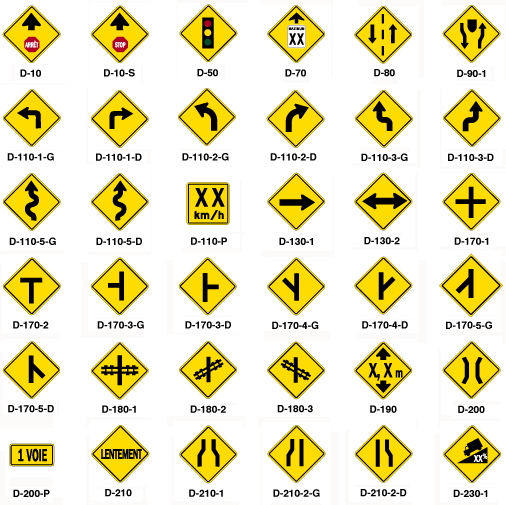

Ride with Traffic - Have your Kids Make a Book!
Younger children understand rules. Have your K through 3rd graders make their own book about rules for bicycling and walking. You can print these signs out and have them cut and paste, then draw or write the rule for each sign. Two 8 1/2 x 11 inch sheets of paper folded twice and cut will form a 16 page booklet. Use more sheets of paper as necessary or fold them only once - five sheets make 10 pages. But you know these tricks!
The point is, have your kids "own" these concepts:
Go with the flow: no wrong way riding
Yield to Pedestrians
Stop at stop signs
Watch for red lights
Watch for slippery spots on the road
Watch out for railroad tracks

The point is, have your kids "own" these concepts:
Go with the flow: no wrong way riding
Yield to Pedestrians
Stop at stop signs
Watch for red lights
Watch for slippery spots on the road
Watch out for railroad tracks
Tuesday, November 9, 2010
NHTSA's Ride Smart, It's Time to Start
This is an earlier version of the NHTSA video on helmet use that we used in Spring 2010 for many of the Snap 'n Strap Helmet Programs for 3rd graders in Fort Collins, Colorado. The video is good for k - 5th grade. Used with an egg or melon drop in a helmet the kids get a kick out of this.
Overview of Bicycle Crash Data and Why We Should Teach Bicycle Safety to Kids
Below is an overview of the nature and severity of bicycle injuries among children and the value of helmet use for children. This "overview" is the preface to a comprehensive survey of thirty bicycle safety training programs around the U.S. undertaken in 1998 by the Harborview Injury Prevention and Research Center at the University of Washington in Seattle. The overview, posted below, provides an excellent survey of a full range of first generation bicycle safety programs. Many of these programs have evolved in 2010 to become state-of-the-art training programs across the U.S. I've included links to just a few here:
Effective Cycling (League of American Bicyclists): now "Smart Cycling" bicycle education program
Travis County (TX) Super Cyclist Program: Now Texas Super Cylcist Program Statewide in Texas
The following post is from
Training Programs for Bicycle Safety
September 3, 1998
by the
Washington Traffic Safety Commission
Harborview Injury Prevention and Research Center
Authors are Frederick P. Rivara, M.D., M.P.H. and Jane Metrik, B.S.
Downloaded 11-9-2010 from http://depts.washington.edu/hiprc/pdf/report.pdf
Overview
Each year approximately 800 bicyclists are killed and as many as 500,000 require emergency room care for injuries. More than one third of all bicyclist deaths occur among youth ages five to 20, and 41% of non-fatal injuries occur to children under the age of 15 years (National Highway Traffic Safety Administration, 1997). Nationally, bicyclists ages 14 and under are at five times greater risk for injury than older cyclists (NHTSA, State Legislative Fact Sheet, 1998). Fatality rates (per million population) for ages 10 to 15 were the highest at 6.46, followed by ages 5 to 9 at 4.58. Similarly with injury rates, children 10 to 15 years old are by far the most vulnerable age category of all age groups (Fatality Analysis Reporting System, NHTSA, 1996). In recent years, injuries to older teens and young adults have accounted for a larger portion of the total. The proportion of pedalcyclists between the ages 25 to 64 involved in crashes that resulted in fatalities was nearly twice as high in 1996 as in 1986 (46% and 25%, respectively).
Washington State was estimated to have 712 total traffic fatalities in 1996, which included 14 (2%) pedalcyclist fatalities (Fatality Analysis Reporting System, NHTSA, 1996). In Washington state, there are approximately 1700 police reported bicycle injuries involving collisions with motorists each year. Over 60 percent of these injuries involve
bicyclists who are 15 years or older. Bicycle injuries are nearly as frequent in the state as pedestrian injuries.
While the majority of bicycle injuries do not involve motor vehicles (MV), collision with vehicles markedly increases the likelihood of serious injury. In the largest study of bicycle injuries conducted to date, investigators at the Harborview Injury Prevention and Research Center (HIPRC) found that MV accounted for 17 percent of all bicycle related
injuries, but increased the likelihood of severe injury by nine fold (Thompson et al, 1996).
Prevention of bicycle injuries can be approached through the use of bicycle helmets, educational programs to improve riding behavior and safety, educational programs aimed at motor vehicle drivers, and environmental changes to decrease the likelihood of bicycle-motor vehicle collisions.
Helmets
Head injuries account for one-third of emergency room visits, two-thirds of hospitalizations, and three-fourths of deaths involving bicycles. Helmets have been shown to be extremely effective in decreasing the risk of head injuries. Rigorous studies indicate that they reduce the risk of head injuries by 85%, and brain injuries by 88% (Thompson, Rivara, and Thompson, 1989). All types of helmets appear to be effective, and they appear to work as well in collisions which involve motor vehicles as they do in falls or other crashes without MV involvement. They work at all ages. In addition, they decrease the risk of injuries to the upper and mid-face by as much as two-thirds.
Although helmets have been determined to be the single most effective way of reducing head injuries and fatalities resulting from bicycle crashes, only 18 percent of all bicyclists wear bicycle helmets (Traffic Safety Fact Sheet, NHTSA,1998). Thus, there is a need for an education program that will increase the knowledge about helmet use and effectiveness. The program developed by the HIPRC has been successful in increasing helmet use from 2% in 1986 to over 50% in 1996. However, use is low among teens and may have decreased in all age groups in the last 2 years.
Other community based bicycle helmet programs have been successful. A common thread to all of them is that they are community-wide, multi-faceted and long term. Nevertheless, many of these educational programs appear to reach a plateau in their effect at about 50% helmet use. Another type of intervention, not mutually exclusive with educational programs, is legislation. NHTSA (1997, p.2) maintains that, “...the enactment of laws requiring the use of bicycle helmets, along with education and visible enforcement, is likely to be the most promising way to increase bicycle helmet usage.” Unfortunately, attempts at getting legislation passed in the state have been unsuccessful over the last 5 years.
Saturday, November 6, 2010
Bicycle Safety New York Style - How Wrong Way Riding Works in NYC
Middle Schoolers love this video of a wrong-way rider in New York City. So it's a great way to grab their attention for a discussion of what wrong way riding means for rules of the road. (It is also a great example of extreme restraint in what might have been an opportunity for bike on pedestrian or pedestrian on bike rage).
Some kids won't automatically process what happened here. So walk them through this after they've watched the video a couple of times.
1) Why was the bike messenger riding down the street the wrong way? (Because he can? Because it's NYC? Because the cops can't be bothered to stop him? Because motorists make way, etc.
2) Why didn't the pedestrian look left, then right, then left before crossing? Because it was a one way street and traffic was coming only from the right (so he thought). Just the reason why you don't want to ride your bike down the street the wrong way - motorists aren't used to looking for vehicular traffic coming from the left.
3) From here move into general rules of the road. Video number 4 (posted in this blog with a complete set of videos) "Ride with The Flow of Traffic"does a great job of following up on this with any age rider. For the complete list of videos click here.
Some kids won't automatically process what happened here. So walk them through this after they've watched the video a couple of times.
1) Why was the bike messenger riding down the street the wrong way? (Because he can? Because it's NYC? Because the cops can't be bothered to stop him? Because motorists make way, etc.
2) Why didn't the pedestrian look left, then right, then left before crossing? Because it was a one way street and traffic was coming only from the right (so he thought). Just the reason why you don't want to ride your bike down the street the wrong way - motorists aren't used to looking for vehicular traffic coming from the left.
3) From here move into general rules of the road. Video number 4 (posted in this blog with a complete set of videos) "Ride with The Flow of Traffic"does a great job of following up on this with any age rider. For the complete list of videos click here.
Friday, November 5, 2010
NHTSA Bike Safe, Bike Smart Film for Middle School Age (9 Minutes)
This is a great film for middle school students and even 4th and 5th graders.
Thursday, November 4, 2010
Become a Fort Collins Master Cyclist!
Become a certified “Smart Cyclist”
Volunteer to Teach Fort Collins’ Youth
Smart Cycling Skills
Fort Collins’ Master Cyclists are experienced cyclists with a passion for “smart” and “safe” cycling. They want to share that passion with the community. Smart cycling is vehicular cycling, also known as “utility cycling” for those who believe that bicycles are a valid form of transportation, especially for short trips to work, to run errands and for recreation. Above all Master Cyclists share their passion through teaching others, speaking to groups, and conducting youth skills bicycle workshops.

Fort Collins’ Master Cyclist program was started by the Bike Co-op in conjunction with the City’s Safe Routes to School Program. The ultimate goal of the Master Cyclist program is to help Fort Collins’ PE teachers teach smart cycling skills to school children, their parents and teachers.
As a Master Cyclist you will undergo a state-of-the-art training developed by the League of American Bicyclists (LAB). Instruction is conducted both online and locally by League Certified Instructors (LCIs). Upon completion of the program you will be certified to conduct youth skills courses (“bike rodeos”) and to teach cycling skills to children under 10 and those 10 to 14 years old.
The training program is FREE for those who agree to volunteer with the Safe Routes to School Program. You need only provide your bicycle, helmet, gloves and a water bottle.
This training program is the same program that local PE teachers, after school program providers, wellness coordinators and parent volunteers will be taking.
Master Cyclists learn:
1. The principles of vehicular cycling
1. Where to ride on the road to be safest and most visible
2. How to “drive your bike” like a car
3. The correct use of bike lanes and sidewalks
4. Rules of the Road

2. Essentials of riding for beginners, including
1. Correct procedures for starting, stopping, mounting and dismounting
2. Straight line riding
3. Scanning, signaling, merging and turning
3. Selection and use of appropriate equipment
1. Bicycle type, size and proper fit
2. Helmet use and the importance of helmets
3. “ABC Quick Check:” bike maintenance and diagnostics
4. Efficient cycling: where bike fit, maintenance, and skills come together
4. Teaching cycling skills to children under 10 (and the importance of reaching their parents)
5. Teaching cycling skills to children 10 to 14
1. How crashes happen and how to avoid them
2. The law as it relates to bicycles and more rules of the road
3. Hazard avoidance
6. Laying out a bicycle skills course (“bike rodeo”) and conducting youth skills classes
7. Practice:
1. On the road
2. On the trail
8. Teaching techniques and bicycle field trips
Training for Master Cyclists involves the following steps:
1. Traffic Skills 101 – an online course offered by the League of the American Bicyclists. You can take this course at www.BikeEd.org. There is no charge for the course. This self-paced course provides the theoretical basis for most of the points mentioned above and takes 3-4 hours.
2. On-the-bike follow-up with a local League Cycling Instructor offers:
1. Parking lot drills and basic handling skills
2. Road rides teach lane positioning, speed positioning and offer practical examples of these.
3. Special needs of children under and over 10 years of age
4. Design and layout of a youth skills course (bike rodeo)
3. Once you’ve completed the above you are a Master Cyclist “in training.
1. Parking lot drills and basic handling skills
2. Road rides teach lane positioning, speed positioning and offer practical examples of these.
3. Special needs of children under and over 10 years of age
4. Design and layout of a youth skills course (bike rodeo)
3. Once you’ve completed the above you are a Master Cyclist “in training.
- Participate in two youth skills courses in the Safe Routes to School program and you have completed your Master Cyclist training.
- You receive your Bicycling 123 Youth Skills Certificate from the League of American Bicyclists.
Once you have completed steps one and two above you will have completed the Traffic Skills 101 class of the League of American Bicyclists. This is a prerequisite course for anyone wishing to go on to achieve their League Cycling Instructor (LCI) certification. LCI certification is offered at weekend seminars around the country several times each year. You can read more about LCI certification and look for seminars that have been scheduled here: http://www.bikeleague.org/programs/education/seminars.php.
Safe Routes to School – Teaching our Children Smart Cycling Skills
Master Cyclists are a critical component of making Fort Collins a safe bicycling community. As a participant in this program you will be encouraged to volunteer to help local schools offer bike skills classes as a part of PE classes, after school programs, and weekend events. Classes will be coordinated through a coalition of local community groups, including The Bike Co-op, the Bicycle and Pedestrian Education Coalition (BPEC), Poudre School District, and the City’s Safe Routes to school Program.
Time Commitment: Mandatory training of approximately ten hours plus commitment to assist with at least two school events within twelve months.
Qualifications:
* Must be sixteen years or older
* Must be an experienced cyclist able to demonstrate mastery of the skills and concepts in the class
* Must pass a background check to work in Poudre Schools
Requirements:
* Assist with two skills classes within twelve months of completing the program
* Regularly work with program coordinator’s and report volunteer hours logged
Benefits
* Become a smarter and safer cyclist
* Help our children become safe cyclists
* Meet people with similar interests
* Be a part of making Fort Collins a friendlier and safer bicycle community
* Take pride in knowing you are helping Fort Collins to become one of the top bicycle communities in the US (even more than it is!)
Safe Routes to School – Teaching our Children Smart Cycling Skills
Master Cyclists are a critical component of making Fort Collins a safe bicycling community. As a participant in this program you will be encouraged to volunteer to help local schools offer bike skills classes as a part of PE classes, after school programs, and weekend events. Classes will be coordinated through a coalition of local community groups, including The Bike Co-op, the Bicycle and Pedestrian Education Coalition (BPEC), Poudre School District, and the City’s Safe Routes to school Program.
Time Commitment: Mandatory training of approximately ten hours plus commitment to assist with at least two school events within twelve months.
Qualifications:
* Must be sixteen years or older
* Must be an experienced cyclist able to demonstrate mastery of the skills and concepts in the class
* Must pass a background check to work in Poudre Schools
Requirements:
* Assist with two skills classes within twelve months of completing the program
* Regularly work with program coordinator’s and report volunteer hours logged
Benefits
* Become a smarter and safer cyclist
* Help our children become safe cyclists
* Meet people with similar interests
* Be a part of making Fort Collins a friendlier and safer bicycle community
* Take pride in knowing you are helping Fort Collins to become one of the top bicycle communities in the US (even more than it is!)
Application Process
1. Complete the online class at this link as soon as possible.
1. Complete the online class at this link as soon as possible.
2. E-mail your final score from this course to education@fcbikecoop.org (cut and paste the page results with your name into your e-mail).
3. We will advise you of on-the-bike follow up classes this winter as they are scheduled.
Information: Rick Price, Ph.D., Safe Cycling Coordinator, Fort Collins Bike Co-op; education@fcbikecoop.org, (970-310-5238).
3. We will advise you of on-the-bike follow up classes this winter as they are scheduled.
Information: Rick Price, Ph.D., Safe Cycling Coordinator, Fort Collins Bike Co-op; education@fcbikecoop.org, (970-310-5238).
Bicycle Safety Videos on YouTube for All Ages
Pueblo, Colorado's Safe Routes to School program has produced a series of ten videos for all ages demonstrating bicycle safety for school kids. The series was produced under the direction of League Cycling Instructor Kim Arline.
Topics include:
1. Bicycle Safety: What is a Bike Train?
2. Wear a properly fitting helmet
3. Ride a Safe Bike
4. Bicycle Safety: Be Visible
5. Bicycle Safety: Ride With the flow of traffic
6. Bicycle Safety: Ride Predictably
7. Bicycle Safety: Sharing the road
8. Sharing Multi-use Trails
9. Walking/Biking Safety: Stay Alert of your Surroundings
10. Finding a route
You can view these on You Tube.
The videos were produced with a Safe Routes to School Education and Encouragement grant. They play regularly on the Pueblo County and Pueblo City Public Access Channels. DVD copies are available.
Visit Pueblo Active Community Environments (P.A.C.E.) for details.
Topics include:
1. Bicycle Safety: What is a Bike Train?
2. Wear a properly fitting helmet
3. Ride a Safe Bike
4. Bicycle Safety: Be Visible
5. Bicycle Safety: Ride With the flow of traffic
6. Bicycle Safety: Ride Predictably
7. Bicycle Safety: Sharing the road
8. Sharing Multi-use Trails
9. Walking/Biking Safety: Stay Alert of your Surroundings
10. Finding a route
You can view these on You Tube.
The videos were produced with a Safe Routes to School Education and Encouragement grant. They play regularly on the Pueblo County and Pueblo City Public Access Channels. DVD copies are available.
Visit Pueblo Active Community Environments (P.A.C.E.) for details.
Tuesday, November 2, 2010
Turn Signals for Bicycles
You are welcome to download or print this small poster for use in your classroom.

Illustration from the 2006 Oregon Bicycle Manual

Illustration from the 2006 Oregon Bicycle Manual
Bicycle Helmets are Required in California and 20 Other States
This post has posters for use by teachers in school to show proper fit for helmets.
Safe Kids Larimer County Bicycle Helmet Poster
The following link takes you to a full color, two-page poster used in California to promote mandatory use of bicycle helmets by those under 18. Note, this poster is a large file so be patient!
California Bike Helmet Poster (Mandatory Helmets were Rejected by the Colorado State Senate in 2010)
Safe Kids Larimer County Bicycle Helmet Poster
View this poster in Spanish Helmet Handout in Spanish
The following link takes you to a full color, two-page poster used in California to promote mandatory use of bicycle helmets by those under 18. Note, this poster is a large file so be patient!
California Bike Helmet Poster (Mandatory Helmets were Rejected by the Colorado State Senate in 2010)
Subscribe to:
Posts (Atom)