In a copyrighted story in the Fort Collins Coloradoan on August 24th, staff writer Trevor Hughes reports on the initiative of the City's assistant bike coordinator, Molly North, to educate bicyclists on the use of bike boxes at the corner of East Plum and Shields Street.
The video tells the story.
Showing posts with label bike culture. Show all posts
Showing posts with label bike culture. Show all posts
Monday, August 29, 2011


Thursday, March 31, 2011
A Bicycle Rider's Perspective on the City Council Race (With endorsements)
Mayor and City Council Cycling Endorsements by David Boerner (published in My Group Ride)
| Friday, 25 March 2011 09:59 | |||||||
 Disclosure: These are the opinions of one man: myself, David Boerner. I am a Fort Collins resident, a cyclist, and a freelance writer with a bit of experience in bike advocacy. These are endorsements based on bicycle friendliness. To find out more about the candidates’ other views, check out the Coloradoan’s Candidates’ Q&As or the Candidates’ websites. Why should we as cyclists care who gets elected to City Council or who is elected mayor? Are they gonna get the Quiznos Classic to come through town? Are they gonna close down the road for Wednesday Night Worlds? What did City Council ever do for me? “City Council affects bicycling in Fort Collins by setting policy that City staff follows. If we continue to elect Council members and a mayor who value the environment, our quality of life, and, yes, bike paths, lanes, and education programs, our bike program will thrive,”Bicycle Advisory Committee Chairman Rick Price explains: And if we don’t, they won’t. Luckily, we’ve had a predominantly bike-friendly Council for years. And that will probably remain true after this election no matter who wins what.But while everyone in Fort Collins politics is perfectly willing to say that “bikes are great,” some are more willing to vote to fund bicycle facilities and programs. Fort Collins uses a council-manager government system, wherein the mayor is not an executive, but a part of the executive body – City Council. The Mayor is more like an at-large Council Member in Fort Collins with one vote, just like the other Council members. City Council seats alternate every other municipal election. This year's election is April 5th and four seats are up for grabs: Mayor, District 2, District 4, and District 6.Therefore, the composition of City Council is what’s important for bike policy, and the mayor is just one part of that picture. Mayor The good news is that all three candidates for mayor identify themselves as cyclists. Karen Weitkunat rides on the trails for recreation and wellbeing. Ross Cunniff identified himself as a “fair-weather commuter.” And Eric Sutherland said, “I’ve commuted to every job I’ve ever had – religiously.” No candidate for mayor of bike-friendly Fort Collins would dare say anything negative about cycling, but some of the candidates were able to get a little more specific about why cycling is good and why they are good for cyclists. Here are the candidates: Weitkunat would probably be a great mayor for cyclists. She’s interested in education and protecting our trails. But she talks too much about “protecting” our bicycle facilities when our bike trails aren’t really in danger. And our “complete streets” planning policy means that future bike lanes are guaranteed.Karen Weitkunat Weitkunat understands very well that Fort Collins’ bicycle friendliness is a major selling point for our city – as do the other candidates. She doesn’t commute by bike, but she runs her business from home, so she doesn’t commute. But she does ride the trails. Weitkunat applauds the bicycle safety education efforts in Fort Collins and said, “it starts with the kids.” Weitkunat has worked with Tim Anderson of the Fort Collins Velodrome Association, and supports the velodrome. Having been in the hospitality industry, Weitkunat understands first-hand the economic benefit of competitive cycling. Weitkunat said that bicycling facilities are a good investment, though she wasn’t as knowledgeable about the funding mechanisms for bike facilities and bike advocacy as some of the other Mayoral and Council candidates – which was surprising, considering her years as a City Council Member. However she’s right on the money in advocating bike education for children, a proven technique for long-term ridership increase in Holland. Eric Sutherland Cunniff said he has “a reasonable level of understanding” about funding for bike projects and advocacy. But he sounded to me like he had the best understanding of any of the mayoral candidates. HOW?I can’t help but love Sutherland after talking to him. Much in contrast to Weitkunat’s optimistic fluff, Sutherland has a much more fiery, grave style. Sutherland seems to make it his mission to uncover what he calls “pseustainability” – disingenuous, “green” marketing. But he’s gotten himself some bad press by challenging New Belgium – a move tantamount to sacrilege in our beer-loving, bike-cruising burg. To clear things up a little bit: Sutherland was right in saying that New Belgium’s “100% wind-powered” marketing was bullshit – and New Belgium stopped saying it. Also, I was told by an anonymous New Belgium employee that New Belgium’s restraining order against Sutherland was unnecessary. In fact, Sutherland’s criticism helped to make New Belgium more transparent and more sustainable. So let’s try not to think about Sutherland as “the guy with the restraining order.” Most of Sutherland’s advocacy has been spent of sustainable energy. He’s a “big-picture” thinker with sustainability, but he said that bikes are an essential part of that picture. Sutherland thinks Fort Collins needs to divert some of its bike advocacy energy away from “boosterism” and into safety and education (although some advocates would argue that “boosterism” is education). He thinks that city engineers and contractors need specific instructions not to reroute bike lanes into automobile traffic during street construction – a phenomenon he calls “cone zones.” And above all, Sutherland said Fort Collins should walk the talk on sustainability, “as opposed to creating PR talking points.” Sutherland would likely push hard on bike policy. Unfortunately, his approach seems to have already burned a few bridges and I think that at attitude of diplomacy could go a long way toward getting good bike policy passed. Ross Cunniff Ross Cunniff talked for about half as long as either Weitkunat or Sutherland, but he said a lot in that time. “I’m familiar with the challenges of bicycling in Fort Collins,” Cunniff said, himself a commuter. “Although we are highly rated [for bicycle-friendliness], there are still things we can improve.” Cunniff advocated education for cyclists and drivers about the status of a bicycle as a vehicle under the Colorado Vehicle Code. Cunniff says that the bike trails and bikeability of Fort Collins are good for Fort Collins’ image and that “bicycles are absolutely good for business.” Mayor Endorsement: Ross CunniffCunniff cited his track record as an advocate for our trail system as evidence of his commitment to bicycling in Fort Collins. Weitkunat repeatedly cited the trails as being a great thing, but she didn’t talk much about what’s next. Cunniff was involved in creating the bike trails and he doesn’t appear likely to rest on his laurels. Cunniff said he will continue “enabling the choice to ride a bicycle.” “What I’ve seen is there’s a feedback loop: as you get more people aware, more people ride bicycles, and the accident rates start to go down. It’s about getting more people on bicycles.” I agree. District 2 Sue PawlakLike every other candidate, Sue Pawlak had good things to say about bicycling in Fort Collins. “It’s a solid reason why people more here in the first place,” Pawlak said. “We need to protect [our bike facilities].” Pawlak has an open mind and was very receptive to my information about the price of bicycle facilities. But she kept bringing up the costs of bicycle facilities too much for my liking. I appreciate her lack of pie-in-the-sky promises. But her understanding of bike issues and funding in Fort Collins was underwhelming. Quite in contrast to her opponent. Lisa Poppaw Poppaw has the best understanding of the funding mechanisms for bicycle facilities and programs of any of the Council or Mayoral candidates I interviewed. She schooled me about the GOCO lottery money that funds our bike trails and explained to me that “the city’s general fund pays for very little of lanes and paths.” “Is cycling a good deal for Fort Collins? Heck yeah, it’s a great deal!” Poppaw has a strong track record on bicycle policy. She helped initiate the recent Bicycle Safety Education Plan, and “supported all the bike initiatives” during her time on Council. Poppaw wants to see education for law enforcement officers about bicycling. She wants to look for funds for overpasses and underpasses on bike corridors. She wants to build a relationship with Poudre School District to get more bike education in schools. Of course, the best story about Poppaw is how a group tried to recall her last year, alleging – among other things – that Poppaw wanted to “eliminate personal vehicle use.” That claim originated from Poppaw’s support of the bicycle parking racks in parking spaces downtown. Apparently the group, called “We Will Not Fail Fort Collins,” didn’t consider bicycles to be “personal vehicles.” It’s not totally fair to support a candidate because she was threatened with recall for supporting bicycles, but it sure makes good copy for a bike racing website. Either way, the choice is clear in District 2. While Pawlak is extremely open-minded to bicycling and would probably vote for sensible bike policy, Poppaw has already proven that she’s right up there with Ben Manvel as being one of cyclists’ best advocates in City Hall. District 2 Endorsement: Lisa Poppaw District 4 Kristin Stephens Stephens doesn’t come into the Council race with any specific bike legislation in mind, but she said she would be in favor of keeping the FC Bikes program that recently lost its grant funding. She thinks our bike friendliness is attractive to businesses. She’s a runner, and a “big advocate of natural areas.” Stephens doesn’t have the experience of some of the other candidates, and she doesn’t have a comprehensive understanding of the funding for bike programs and facilities. But, she says, her opponent “Troxell hasn’t done a good job in any way. He’s not very responsive. He’s rude and not very collaborative. For that reason alone people should vote for me.” Wade Troxell Wade hasn’t returned my multiple calls (although he did respond to the initial email request for his phone number). Being a City Council candidate is a full-time job, and Troxell is a busy man. But if he cared that much about the cyclist vote, he would have called me back. District 4 Endorsement: Kristin Stephens District 6 Gerry HorakGerry Horak, a fine candidate for bicyclists, is running unopposed for District 6. I anticipate that Horak will continue term-limited David Roy’s tradition of bike-friendliness. District 6 Endorsement: Gerry Horak |
Monday, February 21, 2011
Cyclists should set the pace for being a good example
By Rick Price, Ph.D.
First Published in the Coloradoan February 21, 2011
I sometimes hear from readers who think I focus too much on the rights of bicyclists and not on their
responsibilities.
As one reader recently wrote: "I am totally against the buffoons who do not follow the rules, cross the
street against traffic without the signal, cross in front of traffic just because there is a small break in
traffic, wear dark clothing on a dark street after dark, cyclists without lights" and so on.
I agree. So here's one for the "buffoons" out there. If you know one, please pass this along.
Dear fellow bicycle rider:
The Washington, D.C., Area Bicyclist Association, or WABA, adopted a New Year's resolution making
2011 the Year of the Bicycle. They invited every bicyclist in D.C., Maryland and Virginia to sign the
following resolution:
In 2011:
> I resolve to be a more responsible bicyclist.
> I resolve to better respect the rights of other road users.
> I resolve to make a good faith effort to better follow the law.
> I resolve to yield to pedestrians.
> I resolve to help make bicycling safer and easier for all of us.
The resolution was signed by 757 cyclists. That's not many.
Admittedly, WABA had some pushback from its membership. Not everyone agreed to sign the ride
responsibly petition. One member said he could not "imagine how WABA thinks it is going to change
cyclist behavior on these points. This probably will happen about the same time motorists never exceed
the speed limit by a single mile per hour or always signal when they are changing lanes."
When I teach bike safety to kids in local schools, we talk about rules. Even the kindergartners understand
the concept of rules of the road and agree it would be tough to have a football game where one team is
required to follow the rules and the other is allowed to make up their own. They agree this game wouldn't be fair (or fun) for anyone.
So, fellow cyclist think about this as you run that red light or as you race past pedestrians ("walkers"
as the kindergartners call them) in the crosswalk: As minority road users and as the more vulnerable
road users, we need to bite the bullet and set the example. Maybe by adopting these resolutions we
will inspire motorists to join us in practicing correct rules of the road, like yielding to cyclists when we
"take the lane" because it is too narrow to share, coming to a full stop at stop signs on the commute
to work, not exceeding the speed limit, signaling when we change lanes and watching for bikes when
pulling out of alleys, driveways and secondary streets and when opening car doors.
As for those on sidewalks and trails - pedestrians are the more vulnerable users. They have the right
of way. Always. Even the kindergartners understand that rule.
Vote for or against the WABA resolution in the side column of this blog (at the top of the column).
Tuesday, May 4, 2010
Bike Co-op to Hold Bike Town Meeting to Wrap up Community Listening Sessions
When: Wednesday, May 5 from 7 – 9 p.m.
Where: New Belgium Brewing, 500 Linden St. Fort Collins
In order to provide input into the Plan Fort Collins process the Bike Co-op has completed a series of eight community “listening sessions.” About fifty citizens, including cyclists, hikers/pedestrians and motorists came out to express their concerns and visions for a better bicycling community.
Among the concerns expressed for the near-term was a desire for better connections in the existing trail and bike lane system and more and better educational outreach to cyclists in order to reduce conflicts with other users, especially on sidewalks and trails in parks and natural areas.
For the long term the wish list includes increasing the numbers of over- and under-passes along trails like the Mason Trail and the Powerline Trail, including over or under Harmony Road. It was pointed out that grade separated crossings benefit both cyclists and motorists as it eliminates wait times at street crossings for both.

A consistent theme at several of the meetings was the idea of reducing speed limits throughout the City to 35 miles per hour or less. The point was made that if we really want to encourage biking and walking, speed limits should be reduced.
Other ideas brought forward include the concept of “bicycle boulevards” that give cyclists preference to use some neighborhood streets as thoroughfares. Streets nominated for such use included Swallow, Columbia, Stover, Canyon, Oak and Loomis. Bicycle Boulevards encourage cyclists to use through neighborhood streets while motorists might be discouraged through the use of traffic calming devices, signage, and other traffic control features. Stop lights, for example, might default to green for through cyclists while requiring motor vehicles to trigger lights through actuation devices, the opposite of how most City intersections now operate.
A community bike town meeting will be held Wednesday, May 5 from 7 – 9 p.m. at New Belgium Brewing to finalize citizens’ input from these listening sessions. Everyone is encouraged to attend, whether you ride a bicycle, drive a car, or limit your movements to walking. The goal of the meeting will be to review all the suggestions presented and vote on priority actions for the short and long term. A similar bike town meeting was held in November 2007 and resulted in the placement of 35 “share the road” signs throughout the community. Organizers of this meeting hope that new innovative ideas will emerge to present to City planners and to City Council through the City’s Bicycle Advisory Committee and the Transportation Board.
For information about the meeting call 310-5238. Or visit the Bike Co-op web site.
Thursday, March 4, 2010
New Video Shows Cyclists How to "Lead" the Dance with Traffic
Keri Caffrey of CommuteOrlando.com just posted a great video called "Bicycling in Traffic is a "Dance You Must Lead." I suggest you take a look. As you watch it remember the mantra of the vehicular cyclist: "Cyclists fare best when they act and are treated as drivers of vehicles."
You can link to CommuteOrlando.com here.
Bicycling in traffic is a dance you lead from Keri Caffrey on Vimeo.
We'll be discussing the principles illustrated in this video at our Bike Co-op classes Thursday evenings in April. That schedule is here:
You can link to CommuteOrlando.com here.
Bicycling in traffic is a dance you lead from Keri Caffrey on Vimeo.
We'll be discussing the principles illustrated in this video at our Bike Co-op classes Thursday evenings in April. That schedule is here:
| - April 1 . Principles of Traffic Law (in Colorado and in general) - April 8 . How crashes happen and how to avoid them; | |
| -April 15 . Riding basics (classroom); | |
| -April 17 (Saturday) Bike Handling basics . Parking lot drills (1.5 hours) On-the-road practice (1.5 hours) |
Tuesday, January 5, 2010
Both cyclists and drivers can make bicycling safer
Fort Collins Coloradoan, January 4, 2010
by Rick Price, Ph.D. (Safe Cycling Coordinator, The Bike Co-op)
Headed north on College Avenue from Old Town, the motorist shouted something as he passed.
At the light, he continued: "You were in the middle of the lane. Get out of the road! You can't ride in the middle of the road." I gave him my League of American Bicyclist cycling instructor business card as he roared off.
Others have advised me that College Avenue isn't a "bike lane" or that "bicycles are illegal on College Avenue." When I explain that bicycles are prohibited on College Avenue from Laurel Street south to Harmony Road but not in Old Town, people seem surprised. Most don't realize that legally, my bicycle is as much of a vehicle as the SUV or the Prius driving through Old Town.
With this monthly column, I will discuss rules of the road, shared rights and responsibilities, belligerent motorists and scofflaw cyclists. The outcome, I hope, might be a safer cycling and motoring environment.
I'll begin with six basic rules for cyclists and motorists.
> Cyclists are safest when they ride with the flow of traffic. Wrong-way riding is the single biggest cause of bike/car crashes.
> Cyclists are safest riding on the street or road, not on the sidewalk. This reduces conflicts with pedestrians and decreases sidewalk "ride-outs," another cause of bike/car crashes.
> "Share the road" has two meanings, depending on the width of the lane. A 14-foot lane has room for bicycles and motor vehicles side by side. A 12- or 10-foot lane does not, so the League of American Bicyclists teaches cyclists to ride in the center of the lane or just to the right of center, where they are more visible and therefore safer.
> When there are no bike lanes, bicyclists should ride where they feel safest. State law allows this, and with the new 3-foot passing rule, this may mean that cyclists should use the entire lane. In Old Town, with the hazards of diagonal parking, bicycles are safest in the middle of the lane if they chose to ride College, Mountain and LaPorte avenues or Olive, Oak and Magnolia streets. Cyclists no longer should feel the need to pedal in the gutter.
> Bicycling is safe, yet cyclists should wear helmets to protect themselves from the 5 percent of crashes that can’t be avoided. To avoid the 95 percent of crashes that can be prevented, cyclists should ride defensively, avoid falling off their bikes and not allow others to knock them off their bikes.
Bicyclists fare best when they act and are treated as drivers of vehicles. This rule is the mantra of the League of American Bicyclists and dominates 99 percent of the safe cycling curricula taught in the U.S. Different rules apply for children under age 10 and for those between ages 10 to 15.
In the following months, we will examine these common rules more in depth.
Monday, November 9, 2009
City should rethink stance on bike safety
Soapbox in the Coloradoan, Nov. 11, 2009
by Rick Price, Ph.D.
Safe Cycling Coordinator for the Fort Collins Bicycle Cooperative
Thanks go to City Council member Lisa Poppaw for questioning funding for bicycle safety at the Sept. 1 City Council meeting. That question, and the discussion that followed, gave us Traffic Engineer Joe Olsen's study of bike/car crashes, which appeared Nov. 1 on the front page of the Coloradoan.
Although data on bicycling are sparse and the statistics on bike/car crashes are preliminary, we can make some interesting inferences from the data we do have. Hopefully, these inferences will help the City Council rethink funding priorities for the city's bike program.
According to the estimates of the American Community Survey, a project of the U.S. Census, 5.4 percent of commuters rode their bicycles to work daily in Fort Collins in 2006 (about 3,800 people). In 2008, that percentage had risen to 7.4 percent (5,800 people), a jump of 37 percent. With this increase, we saw a 31 percent increase in bike/car crashes compared to annual growth in the single digits for most of the early part of the decade (one exception was the increase of 13.5 percent from 2003 to 2004). (We don't have data on the increases of cyclists during the early part of the decade as this information has been collected only since 2006.)
Based on these statistics and observations, most of us would agree that bicycling in Fort Collins is on the rise and so, it seems, are bike/car crashes. Is this because we reinstated the bike coordinator's position in 2006, or is it because there is a bicycle revolution going on across the country? Probably both, but the alarming increase in bike/car crashes and the deaths in the last year of two children suggest that we have an issue that needs the immediate attention of the City Council.
Our bike coordinator will be funded from federal monies at about $287,500 per year for two years beginning in 2010. Those funds are allocated as follows: $70,000 to promote bicycle events; $70,000 to fund the bike coordinator's position (including benefits and training); and $32,500 to fund "regional bicycle coordination and marketing" so we can help Loveland and Greeley become more bicycle friendly. Finally, $100,000 a year will continue to fund the Bike Library. By comparison, $38,500 of other federal funds will pay for a Safe Routes to School Program during 2009/10. As yet, no funds have been awarded for Safe Routes in 2010/11.
The council has scheduled a work session Feb. 9 to address "transportation safety." That session should focus on a review of the city's bicycle policies and take a serious look at reallocating funds from bicycle events and encouragement to bicycle education. And by education, I mean just that: "providing knowledge and training through formal schooling, teaching and learning," not through pamphlets and posters.
Is it not reasonable, given the present situation in Fort Collins, to suggest that federal funds be reallocated so that we are spending $250,000 annually on bicycle education and $38,500 on encouragement and events?
If you have an opinion on this, please let City Council know.
Tuesday, August 25, 2009
Pedaling Revolution: How Cyclists are Changing American Cities
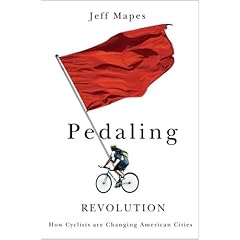
A Book Review by Rick Price, Ph.D.
(by Jeff Mapes, Oregon State University Press, 2009)
The author of Pedaling Revolution, Jeff Mapes, covers politics for the Portland Oregonian;, he is a blogger, a bicycle commuter, and by virtue of having spent nights and weekends from 2004 until April of 2008 thinking about and writing this book, he has become a bicycle advocate. Put him on your list of people to invite to your bike summit or alternative energy fair as recently Mapes was the keynote speaker at such disparate events as the
 energy - SolWestFair - in John Day, Oregon and the Miami Valley Cyclists’ Summit in Dayton, Ohio. (Oh yeah, did I mention, that Mapes’ family just purchased a cargo bike with the capacity to haul 400 lbs of cargo? Now that’s the sign of a committed bicycle advocate.)
So what makes Pedaling Revolution a great book? And what makes Jeff Mapes the latest candidate as spokesperson for our very own bicycle “revolution”? Stories, that’s what, the stock-in-trade of the “literary journalist.”
Mapes is no John McPhee or Tracy Kidder just yet, but he has pulled together a great collection of interviews, stories, and accounts of personal encounters with the people who have made this revolution. And in so doing he reminds us of the value of personal passion, local advocacy, and the role that we all might aspire to play in the revolution. I especially like the nuggets of history and advocacy that he has dredged up in his quest to understand the resurgence of the bicycle in this country.
Take Davis, CA, for example. Why is Davis, widely known as “bike town USA,” head and shoulders above the rest of us for its bike culture? In part, explains Mapes, because of the seeds sown by Davis’s University Chancellor Emil Mrak in the early 1960s. Mrak loved to bicycle and when he became Chancellor he asked his planners and architects to “plan for a bicycle-riding, tree-lined campus.” Then he banned motor vehicles from the central part of campus. The rest is history.
There are other hints of how one person can effect change and help sow the seeds of a bicycle revolution. For example, where did all those bike paths in our bicycle friendly cities come from anyway? Well, you may remember New York Senator Daniel Patrick Moynihan. He was a sociology professor and as a young academic Moynihan wrote an article in 1960 called “New Roads and Urban Chaos,” in which he predicted that urban chaos will break out if States were allowed to build the Interstate Highway system with unrestricted funding from the federal government.
Thirty years later, as chair of the Senate Environment and Public Works subcommittee, Moynihan created local metropolitan planning organizations designed to provide a check and balance on every state’s “roads only” Department of Transportation ( you know, the DOTs) and to mandate that these planning agencies fund “transportation enhancements” that included bike paths and other multi-modal facilities. The result of that legislation is a legacy of nearly two decades of funding for bike paths and bicycle and pedestrian coordinators at the State and city level across the country.
From this personal level of stories about key individuals who have influenced bicycling in the US, Mapes expands his narrative to include a series of readable case studies of cities in Europe and the US. He writes about Amsterdam, Copenhagen and Paris, Chicago, San Francisco and Seattle, and he goes into depth on Davis, Portland, and bicycling in New York City.
You can’t write about the bicycle revolution in the US without exploring the roll of Critical Mass (if you aren’t familiar with “critical mass” your primer is here: http://en.wikipedia.org/wiki/Critical_Mass), urban bike messenger culture, and the controversy within the bicycle community itself over the assertion of people like John Forester, that “cyclists fare best when they act and are treated as drivers of vehicles.” Mapes does all of this and he does it well.
After his great introduction to the recent history of bicycling and bicycle advocacy, Mapes wraps up his narrative in three chapters on bicycle safety, health, and “Bringing Kids Back to Bikes.” It is, in short, a call to arms, to get involved and to bring the revolution to your community. What’s holding you back?
Saturday, August 22, 2009
Big News: The Bike Co-op is Moving!
The Bike Co-op would like to announce that we're moving a few short blocks to a new permanent home at 331 N. College Ave! We just signed the lease yesterday (on Friday). Its awesome, there's nearly 9,000 sq ft of space, it's all heated and insulated, there's plenty of storage, workspace, two bathrooms, a retail area, a great parking lot for test rides, plenty of room out back for donations and recycling. You've just got to see it for yourself to believe it.
Come on down today (Saturday 8/22) at 3pm to 331 N. College if you'd like to lend a hand cleaning it up before we start to move in. Please bring any large push brooms and cleaning supplies you might have available. Then at 5pm this evening we'll be moving Ghana bikes from Steele's market over to the new space. We have a 16' trailer to move them but could use more hands on both ends to speed the process.
Please also plan on joining us tomorrow Sunday 8/23 for a work day (closed to the public) during our normal shop hours Noon-6pm for a work day at 222 Laporte getting things organized for our big move! We will not re-open the shop until everything is moved over to 331 N. College, so please watch for more emails in the upcoming weeks announcing further work/move days.
We will not re-open the shop until everything is moved over to 331 N. College, so please watch for more emails in the upcoming weeks announcing further work/move days.
If you would like to contribute financially, we sure could use some funds to help us offset the costs of repairing/renovating a few areas of our new home, keeping our tools and parts well stocked, and helping out with monthly rent. You can donate via Paypal by credit card, bank account, or Paypal account and all donations are tax decuctible. Please visit our website http://fcbikecoop.org/programs/grants/donations.php and consider a one time or subscription donation. Thank you in advance!
Grinning from ear to ear,
Your Friends at the Fort Collins Bike Co-op
http://fcbikecoop.org/programs/grants/donations.php soon 331 N. College!
Volunteer Opportunities
Come on down today (Saturday 8/22) at 3pm to 331 N. College if you'd like to lend a hand cleaning it up before we start to move in. Please bring any large push brooms and cleaning supplies you might have available. Then at 5pm this evening we'll be moving Ghana bikes from Steele's market over to the new space. We have a 16' trailer to move them but could use more hands on both ends to speed the process.
Please also plan on joining us tomorrow Sunday 8/23 for a work day (closed to the public) during our normal shop hours Noon-6pm for a work day at 222 Laporte getting things organized for our big move! We will not re-open the shop until everything is moved over to 331 N. College, so please watch for more emails in the upcoming weeks announcing further work/move days.
We will not re-open the shop until everything is moved over to 331 N. College, so please watch for more emails in the upcoming weeks announcing further work/move days.
Donations
If you would like to contribute financially, we sure could use some funds to help us offset the costs of repairing/renovating a few areas of our new home, keeping our tools and parts well stocked, and helping out with monthly rent. You can donate via Paypal by credit card, bank account, or Paypal account and all donations are tax decuctible. Please visit our website http://fcbikecoop.org/programs/grants/donations.php and consider a one time or subscription donation. Thank you in advance!
Grinning from ear to ear,
Your Friends at the Fort Collins Bike Co-op
http://fcbikecoop.org/programs/grants/donations.php soon 331 N. College!
Tuesday, May 5, 2009
Polaris High School Freshman to ride the Colorado Trail

Thursday, 30 April 2009 21:07
To whom it may concern:
I would like your assistance in raising money for the Fort Collins Bicycle Co-op. I am looking for sponsors who will contribute directly to the Fort Collins Bicycle Co-op as I spend 2 weeks mountain biking the Colorado Trail. I will cover all my own expenses, carry my own gear, ride during the day and camp out along the 500 miles of trail between Denver and Durango.
I felt I could make my 2 week trip even more rewarding by raising money for the Fort Collins Bicycle Co-op http://fcbikecoop.org/index.php . The Bicycle Co-op is a nonprofit organization that promotes the health, environmental and economic benefits of bicycling in Fort Collins and abroad. They do this primarily by collecting and repairing old bikes and reusing them here as well as in developing nations over-seas.
There are several ways you can support my cause for a more bicycle friendly world. You can go directly to the Fort Collins Bicycle Co-op web site and donate on line at the Fort Collins Bike Co-op or mail a check to the Fort Collins Bicycle Co-op 222 Laporte Avenue Fort Collins, CO 80521. If you prefer you can pledge a donation now, either a set amount or a dollar-per-mile amount and I will collect from you after I finish in July. If you contribute direcly to the Bicycle Co-op please let me know so I can track it.
Thank you for your support. I appreciate your contribution.
Sincerely,
Cassi Mason
tony@greyrock.org
freshman Polaris High School
Friday, March 6, 2009
New Belgium Recognized as Platinum Bicycle Friendly Business

Congratulations to New Belgium Brewing! This just in from the League of American Bicyclists. The photo shows New Belgium Brewing in Fort Collins hosting a winter bike to work breakfast.
Washington, DC - March 05, 2009 – The League of American Bicyclists is proud to announce New Belgium Brewing is named as a platinum level Bicycle Friendly Business and is one of the 34 new BFB award winners. This is the second time BFB winners have been announced since the program's inception in 2008 when the League announced the first 13 designees.
“We’re delighted to highlight New Belgium and the ways in which they are getting more people on bikes,” stated League President Andy Clark. “In today’s challenging economic climate, businesses with healthy, happy and productive employees are going to be the most competitive and the most sustainable – the Bicycle Friendly Business program recognizes some of the best examples of this in practice.”
The BFB program recognizes socially responsible businesses that promote healthy, happy, and green workplaces and provides a road map to become even more bicycle-friendly in the years to come. “Businesses across the nation are rising to the challenge of reducing their carbon footprint and improving the health of their employees - we are excited to be able to provide a roadmap to help achieve both these goals, and to recognize those companies that are leading the way," said Clark.
“It’s an honor to be recognized at the League’s highest platinum level rating,” said New Belgium spokesman, Bryan Simpson. “As a brewery founded on a bike ride through Belgium, we do bike advocacy from Tour de Fat to Team Wonderbike because it’s an important part of who we are and how we want to manifest on this planet.”
Bicycle Friendly Businesses are corporations, organizations, nonprofits and associations that weave bicycling into their business culture and give employees and customers the opportunity to be active stewards of their personal and environmental health through bicycling. When bicycling is infused in an office or company culture, great things happen: reduced health care costs; more productive employees; improved worker and customer; satisfaction; smaller carbon footprint; and increased corporate social responsibility.
Applying as a BFB is easy and free. Applicants receive technical assistance from the League staff as well as tools to evaluate and assess their bicycle friendliness through the application process. The BFB application is available online at www.bicyclefriendlybusiness.org.
Sunday, February 15, 2009
Bike to Breakfast in Portland & Salem, Why not Fort Collins?
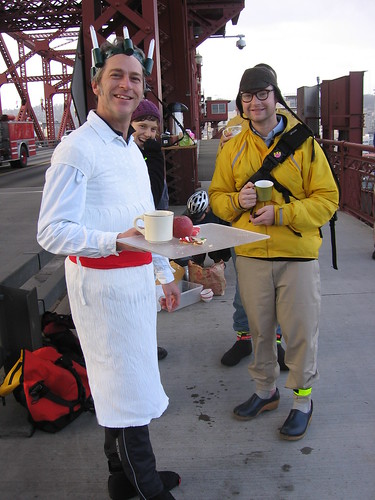
In Fort Collins our City Bike Coordinator throws a breakfast bash during Bike to Work Week in late June and during Winter Bike to Work Day in December. Click here for photos of this last December.
But in Portland and Salem, Oregon they do Bike to Breakfast monthly! I've linked to some photos here and suggest we consider a monthly bike to breakfast to encourage more pedaling, more camaraderie, and more visibility for bicycle commuting. The difference from what we now do twice a year, with fancy breakfasts, corporate hosts, pancakes, heaters, and all and what Portland and Salem do is simplicity. They just serve coffee, juice and sweet rolls. Of course in Portland they do Breakfast on the Bridges over the Willamette River with great views. But still . . . we could find one place, one host, and do a simple gathering the last . . . take your pick, Wednesday, every month.
BUT - This is a job for the community NOT the City Bike Coordinator. As the recent Community Bike Safety Forum (see post below) indicated, the community thinks our Bike Coordinator should focus on safety, not encouragement. So let's get Bike Fort Collins to sponsor a breakfast, then Diamond Peaks, then Rotary, then New Belgium, then . . . . . are you with me?
Check out Portland's Bridge Breakfasts here.
And Salem's breakfast by bike here.
And the photos here.
Monday, February 9, 2009
Bike Forum Thursday, February 12, 2009
How Can we Create a Safer Bicycle Culture in Fort Collins? A Community Cyclists Forum
Cyclists to Discuss Bicycle Safety at Community Forum on Feb. 12
The forum will take place from 6 to 8 p.m. on Thursday, Feb. 12, at the Drake Centre, 802 W. Drake Road. Click for details.
Cyclists to Discuss Bicycle Safety at Community Forum on Feb. 12
The forum will take place from 6 to 8 p.m. on Thursday, Feb. 12, at the Drake Centre, 802 W. Drake Road. Click for details.
Monday, February 2, 2009
How Can we Create a Safer Bicycle Culture in Fort Collins? A Community Cyclists Forum
Cyclists to Discuss Bicycle Safety at Community Forum on Feb. 12
The forum will take place from 6 to 8 p.m. on Thursday, Feb. 12, at the Drake Centre, 802 W. Drake Road.
The Colorado State University Center for Public Deliberation, or CPD, will host the “Bicycle Safety Summit,” a community forum to discuss bicycle safety in Fort Collins.
Although Fort Collins has been recognized as one of the nation’s most bicycle-friendly communities by the League of American Bicyclists, developing safe cycling practices is still a work in progress.
Recent public concerns regarding safe cycling issues, and the deaths of two cyclists, are leading city officials to turn to the community in search of solutions.
David “DK” Kemp, City of Fort Collins Bicycle Coordinator, said that the goal of the “Bicycle Safety Summit” is to respond to safety concerns in the community, with a goal of gathering ideas for creating a stronger culture of safety in the community.
“We need to acknowledge that the city cannot fix the issue on its own,” Kemp said. “Community involvement and cultural change is essential to finding a solution.”
The forum is designed to gather concerns and ideas for action at all levels of involvement. The idea of a “summit” is symbolic of the collaboration of individuals, the community, local organizations and government.
“One of the hopes of the CPD is to help our community think of all the different ways we can approach issues,” said Martin Carcasson, CPD Director. “This is an issue where a simple policy solution is not likely, but rather requires us to work together as a community at multiple levels.”
The forum is co-sponsored by the City of Fort Collins and local cycling organizations, Bike Fort Collins and the Fort Collins Bicycle Co-Op. The event is open to the public, and community members are encouraged to participate.
Light refreshments will be provided. Non-partisan student facilitators from the CPD will moderate the forum, and the discussion will be documented to ensure that concerns, ideas and questions will be addressed. The results compiled at the forum will be utilized by the City of Fort Collins and cycling organizations to move forward on this issue.
About the CSU Center for Public Deliberation
The CPD was founded in 2006 and is dedicated to enhancing local democracy through improved public communication and community problem solving. The organization coordinates and hosts numerous events in the Fort Collins and Loveland communities. Student associates are trained as non-partisan facilitators and conveners, and focus on helping the public unite and address critical issues in a more effective manner.
Saturday, January 3, 2009
Is Steamboat’s Claim to Ski Fame a Lesson for Fort Collins?


No, we have no hopes of becoming a ski town, but what about 70 Olympic athletes training here and people coming from all over the country because we’re the cycling capital of the US?
That’s the hope, anyway of the Fort Collins Velodrome Association.
The example from Steamboat isn’t all that farfetched. Read how Howelsen Hill in Steamboat got started as the only ski resort in Colorado to make the Colorado State Register of Historic Places. One of the oldest operating ski resorts in the country, National Public Radio did a feature on the ski area in December 2008.
So why not a Fort Collins cycling park, criterium course, and indoor (or outdoor) velodrome to replicate Howelsen Hill?
The photos show kids from 6 - 16 on an Italian velodrome in Forli, Italy.
Wednesday, December 31, 2008
Fort Collins' Mayor Hutchinson Defends Bike Library

In a copyrighted story in the Loveland Reporter-Herald Dec. 30, 2008 Anthony Bowe wrote about Tom Coburn, Republican Sentator from Oklahoma who listed the Fort Collins Bike Library as one of the most wasteful federal projects in 2008. Mayor Hutchinson is quoted as saying:
“I was surprised that he would pick out something like that, . . . . I don’t think it’s a waste. It’s in the DNA in a lot of people in Fort Collins. This is a very modest amount of money, and it really adds to the quality of the bicycle environment in Fort Collins.”
You tell 'em, Mayor.
Indeed, the City spent nothing on the Bike Library, the Downtown Development Authority provided $15,000 in matching funds and free rent on the Bike Library Kiosk in Old Town Square and local businesses provided $17,000 of in-kind donations to operate it. The feds, through the Congestion Mitigation and Air Quality (CMAQ) program povided $132,000 over two years.
Estimates vary but with 70% of Library users from out of town, authorities believe that the program has brought the community several hundred thousand dollars of publicity and tourism dollars in its first year of operation.
The Library is operated primarily by volunteers through the Fort Collins Bike Co-op and Bike Fort Collins and though winter hours have been cut back significantly, the library will expand operations in the spring of 2009 with a fleet of about 220 bicycles.
Visit the Bike Library web site by clicking here.
Tuesday, December 30, 2008
US News and World Report Says: Bike to Work! Best Way to Improve Health in 2009!
That's right, THE US News and World Report has ID'd Bicycling to Work as one of the top ways to improve your LIFE in 2009, not just your health. We tend to agree. Read the article here.
Oriello posted the following comment on their web site:
Get organized and bike to work
Biycle commuting is really just about adopting good habits over bad habits. Biking to work will require you to be more organized, to plan ahead, to be prepared (remember the scouts?) and to put your coat on (remember your mother's words?) Once you get in the habit of leaving a little early you'll find biking to work is a lot easier. Have a look at our blog in Fort Collins, CO (free bikes at our bike library!)
Sunday, December 21, 2008
Are We On Our Way to A National Bicycle Policy?
Will the Obama administration bring us a National Bicycle Policy?
If you follow the news and read the blogs there are hints that we may be working our way that direction – a big change from the policies of the Bush administration. It was his Secretary of Transportation, Mary Peters, after all who said that we were wasting federal tax dollars by building bike paths and trails which are “not really transportation.”
If you are interested in following these developments, here are just a few of the people and policies you might want to watch:
1) Oregon Congressman Earl Blumenauer’s “bicycle commuter act” allows employers to provide $20 per month annually to incentivize bicycle commuters. Use it to pay for secure bike parking, buy a bike, or buy the equipment necessary for safe cycling. This bill passed as a rider in the famous Wall Street “bailout.” Sort of a default “gift” from the Bush administration.
2) Congressman Ray LaHood, an Illinois Republican, is leaving the House to become Secretary of Transportation. Lahood is a moderate Republican who has been a friend of bicycling according to Ed Barsotti, head of the League of Illinois Bicyclists. Read Barsotti’s thoughts on LaHood here. Among others, LaHood favors Rails to Trails and has spoken in favor of the Transportation Enhancements program that gives us most of the nation’s bike paths and bike lanes.
3) The National Park Service will allow park superintendents to open new trails in our national parks to mountain biking according to a ruling published in the Federal Register. Maybe one good thing to come out of the Bush administration? Read more about this at Spokes ‘n’ Folks.
4) The Adventure Cycling Association (ACA) reports that a US Bike Route System is in the works. The biggest news here is that it involves both ACA and AASHTO, the (American Association of State High Transportation Officials). This latter group
“foster[s] the development, operation, and maintenance of an integrated national transportation system. So having these highway geeks thinking about a national bike route is a big deal. Learn more at the Adventure Cycling Association.
5) Last, but not least, UPS has begun bicycle deliveries during peak times in some areas. The NYTimes reports that story in a copyrighted story Dec. 19, 2008. Raise your hand if you’d like to be a UPS bicycle delivery person when you grow up!
Follow all these stories and more in John Hopkins’ blog, Spokes ‘n’ Folks from the Green Mobility Network.
Saturday, December 20, 2008
Use of Cell Phones and Cycling Safety
Bike Fort Collins has begun a campaign to educate citizens and decision makers about the dangers of using a cell phone while driving a 5,000 lb. vehicle on City streets. Have a look at their web page on the issue.
The goal is to make motorists aware of the danger they present to cyclists when distracted by their cell phone. In a "real" bike town, motorists would be aware of this. We're working on it in Fort Collins. Should city council ban the use of cell phones while operating a motor vehicle? Answer our poll to the left.
The goal is to make motorists aware of the danger they present to cyclists when distracted by their cell phone. In a "real" bike town, motorists would be aware of this. We're working on it in Fort Collins. Should city council ban the use of cell phones while operating a motor vehicle? Answer our poll to the left.
Thursday, December 18, 2008
Creating a Bicycle Culture

By Anthony Ben'jammin' DeNardo III
[This Soapbox was published in the Fort Collins Coloradoan Monday, December 15, 2008; Anthony sits on the Board of the Fort Collins Bike Co-op]
We've built a gold level bicycle friendly community according to the League of American Bicyclists. But motorists killed two bicycle riders - in bike lanes - on city streets just four months apart. Why?
Perhaps we’ve failed to create the culture that goes with our bicycle infrastructure? Italians have a reputation as being bad drivers yet Italy is considered to have a great bicycle culture. Almost everyone rides a bike: small children go to school on their mother’s bike and the elderly ride all the time. In Italy, motorists see bicycles everywhere and they respect them since the cyclist on the road could be their grandmother.
We promote a world-class bicycle infrastructure in Fort Collins and, while the bike plan speaks to education and enforcement issues, they are not addressed very aggressively. In short, we’ve no plan to build a bicycle culture. It’s time we begin to move from a “car culture” to a “car, bicycle and pedestrian culture.” Here’s one idea on how to start.
Police Services moved to Timberline Road last year at the same time that City Council approved a two-year lease for the Fort Collins Bike Co-op at the Poudre Valley Creamery. Until last winter Police Services collected, tracked, impounded, and handled all abandoned and stolen bikes in the community. Those tasks are now all handled by volunteers at the Bike Co-op.
Today the City is saving the cost of one full-time equivalent staff person ($38,000 average) plus benefits ($15,000?) NOT counting police cruiser and officers’ time to retrieve bikes. So the Bike Co-op is saving taxpayers around $60,000 annually. Why not use some of that savings to help create a bike culture?
The Co-op could work with the City Bicycle Coordinator to develop and take bicycle safety seminars to public schools. The City’s Bike Library fleet could be used for field trips on the Poudre Trail. Parents and educators should be made a part of the process since most are motorists and can benefit from this cultural education as well.
Fifteen to twenty thousand new people move to Fort Collins every year. Most are CSU students and many have never lived in a “bike town” before. CSU needs a bike “coordinator” who, in cooperation with the City’s bike coordinator, can teach those newcomers what life in “bike town” is like: be predictable, use lights at night, stop at stop signs and lights, go the right way in the bike lane, and more.
City and CSU Police need to become engaged in helping to create this culture. They don’t have time or staff, they might argue. But some of the friendliest bike towns in the US have police forces that undertake “sting” operations to enforce cyclists’ stopping at stop signs and using lights at night for several days a year, namely at the beginning of the academic year. Maybe City Council could help them find the time.
And maybe now is the time to quit talking about what a great bicycle town this is and to start creating the appropriate culture.
Subscribe to:
Posts (Atom)