Fort Collins Coloradoan, January 4, 2010
by Rick Price, Ph.D. (Safe Cycling Coordinator, The Bike Co-op)
Headed north on College Avenue from Old Town, the motorist shouted something as he passed.
At the light, he continued: "You were in the middle of the lane. Get out of the road! You can't ride in the middle of the road." I gave him my League of American Bicyclist cycling instructor business card as he roared off.
Others have advised me that College Avenue isn't a "bike lane" or that "bicycles are illegal on College Avenue." When I explain that bicycles are prohibited on College Avenue from Laurel Street south to Harmony Road but not in Old Town, people seem surprised. Most don't realize that legally, my bicycle is as much of a vehicle as the SUV or the Prius driving through Old Town.
With this monthly column, I will discuss rules of the road, shared rights and responsibilities, belligerent motorists and scofflaw cyclists. The outcome, I hope, might be a safer cycling and motoring environment.
I'll begin with six basic rules for cyclists and motorists.
> Cyclists are safest when they ride with the flow of traffic. Wrong-way riding is the single biggest cause of bike/car crashes.
> Cyclists are safest riding on the street or road, not on the sidewalk. This reduces conflicts with pedestrians and decreases sidewalk "ride-outs," another cause of bike/car crashes.
> "Share the road" has two meanings, depending on the width of the lane. A 14-foot lane has room for bicycles and motor vehicles side by side. A 12- or 10-foot lane does not, so the League of American Bicyclists teaches cyclists to ride in the center of the lane or just to the right of center, where they are more visible and therefore safer.
> When there are no bike lanes, bicyclists should ride where they feel safest. State law allows this, and with the new 3-foot passing rule, this may mean that cyclists should use the entire lane. In Old Town, with the hazards of diagonal parking, bicycles are safest in the middle of the lane if they chose to ride College, Mountain and LaPorte avenues or Olive, Oak and Magnolia streets. Cyclists no longer should feel the need to pedal in the gutter.
> Bicycling is safe, yet cyclists should wear helmets to protect themselves from the 5 percent of crashes that can’t be avoided. To avoid the 95 percent of crashes that can be prevented, cyclists should ride defensively, avoid falling off their bikes and not allow others to knock them off their bikes.
Bicyclists fare best when they act and are treated as drivers of vehicles. This rule is the mantra of the League of American Bicyclists and dominates 99 percent of the safe cycling curricula taught in the U.S. Different rules apply for children under age 10 and for those between ages 10 to 15.
In the following months, we will examine these common rules more in depth.
Showing posts with label advocacy. Show all posts
Showing posts with label advocacy. Show all posts
Tuesday, January 5, 2010


Wednesday, October 28, 2009
Phys Ed: Do More Bicyclists Lead to More Injuries
Great article by Gretchen Reynolds in yesterday's NY Times Blog
Recently, surgeons and emergency room physicians at the Rocky Mountain Regional Trauma Center in Denver noticed a troubling trend. They seemed to be seeing cyclists with more serious injuries than in years past. Since many of the physicians at the hospital, a Level I trauma center serving the Denver metropolitan area, were themselves cyclists, they wondered if their sense of things was accurate.
So the doctors began gathering data on all cycling-related trauma admittances at the hospital and dividing them into two blocks, one covering 1995-2000 and the other 2001-6.
The data, which were presented in mid-October at the 2009 Clinical Congress of the American College of Surgeons in Chicago, revealed “some pretty alarming things,” said Dr. Jeffry Kashuk, an associate professor of surgery at the University of Colorado School of Medicine, attending physician at the trauma center and an author of the study. Over the years, the severity of the bodily damage, as measured by a standardized injury severity score, had significantly increased. The number of chest injuries rose by 15 percent, while abdominal injuries tripled. The typical length of cyclists’ time in the intensive care unit grew. Meanwhile, the average age of the injured riders had risen, from 25 to about 30, and when the researchers plotted the most recent injury sites against a map of the Denver area, they found smatterings of accidents along bike paths, but large clusters downtown.
“What we concluded was that a lot of these people were commuters,” Dr. Kashuk said, adding, “If we keep promoting cycling without other actions to make it safer, we may face a perfect storm of injuries in the near future.”
There has been an enormous push in recent years to increase bicycle ridership, in hopes of improving both individual health and the environment. Cities like Denver, New York and Portland, Ore., have added bike lanes, given away helmets and otherwise tried to lure more cyclists onto the roads. But the Denver study seemed to indicate that getting more people to ride meant more would be hurt.
But that is not necessarily so, a well-established body of counterintuitive science promises. This research, which has examined bicycle-riding patterns in the United States and in Europe, has found that in virtually every instance, when the number of riders on the road increases, the likelihood of accidents declines. This surprising result is known among its researchers as the “safety in numbers” effect, and it has been repeatedly documented. In Britain, for instance, the number of cyclists soared by 70 percent during the oil crisis of the 1970s, a 2002 report on cycling safety there pointed out, but the number of annual deaths among cyclists then fell.
Similarly, in the Netherlands, a nation that loves its bicycles, the level of bike use rose 30 percent from 1980 to 1990, while the number of cycling-related deaths declined by a third. Closer to home, when a California public-health expert compiled data about accidents involving cyclists and walkers in major cities in California, he found that, as his 2003 study reported, “the likelihood of an injury is not constant, but decreases as walking or bicycling increases.”
How can more cyclists mean fewer accidents? “It seems unlikely that people walking or bicycling obey traffic laws more” just because more of them are on the streets, the author of the California study wrote. “Adaptation in motorist behavior seems more plausible.” In other words, when more cyclists show up on the roads, car drivers become used to them and respond appropriately. As the British report pointed out, “common events are safe, and rare events are dangerous.” Making cycling safer, the report concluded, “ requires that it become more popular.”
There is a Catch-22 in that proposition, of course, and studies like the one from Denver underscore the issue’s complexity. In the early stages of increasing bike ridership, injuries may increase, as may their severity, since drivers will not yet be acclimated to the influx of two-wheeled traffic (and many of the early-adapter riders will not be attuned to the nuances of negotiating in traffic). At the same time, according to surveys conducted over the years by researchers at the Harvard School of Public Health, most people say that the primary reason they do not ride bikes is a concern for safety. So reports about an increase in injuries, even if it were ultimately short-lived, could blunt the rise in ridership, making those who do cycle less safe.
What, then, can be done? No solutions are easy, said Dr. Walter Willett, chairman of the department of nutrition at the Harvard School of Public Health and an avid cyclist who, with others in his department, is studying how best to increase bicycle safety. “It’s definitely a good idea to promote bicycle riding for a multitude of reasons, foremost among them better health,” Dr. Willett said. “But as with any health-related intervention, there are benefits and side effects.”
Transportation experts cannot agree, for instance, about whether to segregate bicycle and automobile traffic, using concrete barriers along bike paths or creating separate bikeways. In the short term, such an approach should protect cyclists. But if if drivers are not given the opportunity to acclimate to riders, will it actually make it more dangerous for bikers in the long run? No one knows. “We need studies; we need data,” Dr. Willett said.
In the meantime, as more cyclists are taking to the roads but drivers and cyclists have not yet reached an accommodation, individual responsibility seems the best response. Bicyclists must obey traffic laws, an obvious prescription often flouted, at least according to a study in May of cycling behavior in Midtown Manhattan. It found that many riders ran red lights and illegally ribboned through traffic. Even more egregiously, an April epidemiological study of bicycle fatalities in New York City from 1996 to 2005 reported that alcohol was detected in 21 percent of the cyclists killed.
Finally, do not assume that, should you dutifully follow the rules, you are freed from constant vigilance. Individual driving behavior, no matter how many cyclists ride, will always remain unpredictable, if not perverse. Consider the results of a 2007 study from Britain, which found that, when cyclists skipped wearing helmets, drivers yielded more of the road to them while passing; if the cyclists did don their helmets, the drivers tended to crowd dangerously close.
Recently, surgeons and emergency room physicians at the Rocky Mountain Regional Trauma Center in Denver noticed a troubling trend. They seemed to be seeing cyclists with more serious injuries than in years past. Since many of the physicians at the hospital, a Level I trauma center serving the Denver metropolitan area, were themselves cyclists, they wondered if their sense of things was accurate.
So the doctors began gathering data on all cycling-related trauma admittances at the hospital and dividing them into two blocks, one covering 1995-2000 and the other 2001-6.
The data, which were presented in mid-October at the 2009 Clinical Congress of the American College of Surgeons in Chicago, revealed “some pretty alarming things,” said Dr. Jeffry Kashuk, an associate professor of surgery at the University of Colorado School of Medicine, attending physician at the trauma center and an author of the study. Over the years, the severity of the bodily damage, as measured by a standardized injury severity score, had significantly increased. The number of chest injuries rose by 15 percent, while abdominal injuries tripled. The typical length of cyclists’ time in the intensive care unit grew. Meanwhile, the average age of the injured riders had risen, from 25 to about 30, and when the researchers plotted the most recent injury sites against a map of the Denver area, they found smatterings of accidents along bike paths, but large clusters downtown.
“What we concluded was that a lot of these people were commuters,” Dr. Kashuk said, adding, “If we keep promoting cycling without other actions to make it safer, we may face a perfect storm of injuries in the near future.”
There has been an enormous push in recent years to increase bicycle ridership, in hopes of improving both individual health and the environment. Cities like Denver, New York and Portland, Ore., have added bike lanes, given away helmets and otherwise tried to lure more cyclists onto the roads. But the Denver study seemed to indicate that getting more people to ride meant more would be hurt.
But that is not necessarily so, a well-established body of counterintuitive science promises. This research, which has examined bicycle-riding patterns in the United States and in Europe, has found that in virtually every instance, when the number of riders on the road increases, the likelihood of accidents declines. This surprising result is known among its researchers as the “safety in numbers” effect, and it has been repeatedly documented. In Britain, for instance, the number of cyclists soared by 70 percent during the oil crisis of the 1970s, a 2002 report on cycling safety there pointed out, but the number of annual deaths among cyclists then fell.
Similarly, in the Netherlands, a nation that loves its bicycles, the level of bike use rose 30 percent from 1980 to 1990, while the number of cycling-related deaths declined by a third. Closer to home, when a California public-health expert compiled data about accidents involving cyclists and walkers in major cities in California, he found that, as his 2003 study reported, “the likelihood of an injury is not constant, but decreases as walking or bicycling increases.”
How can more cyclists mean fewer accidents? “It seems unlikely that people walking or bicycling obey traffic laws more” just because more of them are on the streets, the author of the California study wrote. “Adaptation in motorist behavior seems more plausible.” In other words, when more cyclists show up on the roads, car drivers become used to them and respond appropriately. As the British report pointed out, “common events are safe, and rare events are dangerous.” Making cycling safer, the report concluded, “ requires that it become more popular.”
There is a Catch-22 in that proposition, of course, and studies like the one from Denver underscore the issue’s complexity. In the early stages of increasing bike ridership, injuries may increase, as may their severity, since drivers will not yet be acclimated to the influx of two-wheeled traffic (and many of the early-adapter riders will not be attuned to the nuances of negotiating in traffic). At the same time, according to surveys conducted over the years by researchers at the Harvard School of Public Health, most people say that the primary reason they do not ride bikes is a concern for safety. So reports about an increase in injuries, even if it were ultimately short-lived, could blunt the rise in ridership, making those who do cycle less safe.
What, then, can be done? No solutions are easy, said Dr. Walter Willett, chairman of the department of nutrition at the Harvard School of Public Health and an avid cyclist who, with others in his department, is studying how best to increase bicycle safety. “It’s definitely a good idea to promote bicycle riding for a multitude of reasons, foremost among them better health,” Dr. Willett said. “But as with any health-related intervention, there are benefits and side effects.”
Transportation experts cannot agree, for instance, about whether to segregate bicycle and automobile traffic, using concrete barriers along bike paths or creating separate bikeways. In the short term, such an approach should protect cyclists. But if if drivers are not given the opportunity to acclimate to riders, will it actually make it more dangerous for bikers in the long run? No one knows. “We need studies; we need data,” Dr. Willett said.
In the meantime, as more cyclists are taking to the roads but drivers and cyclists have not yet reached an accommodation, individual responsibility seems the best response. Bicyclists must obey traffic laws, an obvious prescription often flouted, at least according to a study in May of cycling behavior in Midtown Manhattan. It found that many riders ran red lights and illegally ribboned through traffic. Even more egregiously, an April epidemiological study of bicycle fatalities in New York City from 1996 to 2005 reported that alcohol was detected in 21 percent of the cyclists killed.
Finally, do not assume that, should you dutifully follow the rules, you are freed from constant vigilance. Individual driving behavior, no matter how many cyclists ride, will always remain unpredictable, if not perverse. Consider the results of a 2007 study from Britain, which found that, when cyclists skipped wearing helmets, drivers yielded more of the road to them while passing; if the cyclists did don their helmets, the drivers tended to crowd dangerously close.
Tuesday, September 22, 2009
Deadline to Join a City Citizens' Advisory Board Extended to Oct. 12
The post below is still valid but the following boards or commissions received few applicants so the City has extended the deadline to Oct. 12.
- Affordable Housing Board
- Air Quality Advisory Board
- Community Development Block Grant Commission
- Landmark Preservation Commission
- Senior Advisory Board
- Women's Commission
- Zoning Board of Appeals
Just wanted to let everyone know that the application deadline has been extended to October 12 for boards and commissions. Applications will be accepted for all boards and commissions, however, the following received equal to or less than the number of vacancies:
Fort Collins City Council relies on boards and commissions for advice on policy issues, on how to spend money, and on many other things. We can build a better bicycle community with more cyclists on these citizen boards or commmissions. The application process is pretty simple. You'll then have an interview with a couple of Council members, and then they'll decide. Time commitments are 4 - 8 hours per month on most boards or commissions.
We would really like to see cyclists on the following boards:
Air Quality Board
Art in Public Places (we need more bike Art!)
Downtown Development Board
Economic Advisory Commission
Land Conservation and Development Commission
Natural Resources Advisory Board
Planning & Zoning Board
Senior and Youth Advisory Boards
Women's Commission and others....
Visit the City web site for more information and for application procedures.
Applications are due Sept. 30, 2009.
If you have questions about how all this relates to better bicycling in Fort Collins call Rick Price at 310-5238.
- Affordable Housing Board
- Air Quality Advisory Board
- Community Development Block Grant Commission
- Landmark Preservation Commission
- Senior Advisory Board
- Women's Commission
- Zoning Board of Appeals
Just wanted to let everyone know that the application deadline has been extended to October 12 for boards and commissions. Applications will be accepted for all boards and commissions, however, the following received equal to or less than the number of vacancies:
Fort Collins City Council relies on boards and commissions for advice on policy issues, on how to spend money, and on many other things. We can build a better bicycle community with more cyclists on these citizen boards or commmissions. The application process is pretty simple. You'll then have an interview with a couple of Council members, and then they'll decide. Time commitments are 4 - 8 hours per month on most boards or commissions.
We would really like to see cyclists on the following boards:
Air Quality Board
Art in Public Places (we need more bike Art!)
Downtown Development Board
Economic Advisory Commission
Land Conservation and Development Commission
Natural Resources Advisory Board
Planning & Zoning Board
Senior and Youth Advisory Boards
Women's Commission and others....
Visit the City web site for more information and for application procedures.
Applications are due Sept. 30, 2009.
If you have questions about how all this relates to better bicycling in Fort Collins call Rick Price at 310-5238.
Tuesday, August 25, 2009
Pedaling Revolution: How Cyclists are Changing American Cities
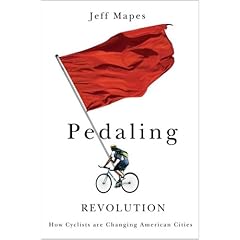
A Book Review by Rick Price, Ph.D.
(by Jeff Mapes, Oregon State University Press, 2009)
The author of Pedaling Revolution, Jeff Mapes, covers politics for the Portland Oregonian;, he is a blogger, a bicycle commuter, and by virtue of having spent nights and weekends from 2004 until April of 2008 thinking about and writing this book, he has become a bicycle advocate. Put him on your list of people to invite to your bike summit or alternative energy fair as recently Mapes was the keynote speaker at such disparate events as the
 energy - SolWestFair - in John Day, Oregon and the Miami Valley Cyclists’ Summit in Dayton, Ohio. (Oh yeah, did I mention, that Mapes’ family just purchased a cargo bike with the capacity to haul 400 lbs of cargo? Now that’s the sign of a committed bicycle advocate.)
So what makes Pedaling Revolution a great book? And what makes Jeff Mapes the latest candidate as spokesperson for our very own bicycle “revolution”? Stories, that’s what, the stock-in-trade of the “literary journalist.”
Mapes is no John McPhee or Tracy Kidder just yet, but he has pulled together a great collection of interviews, stories, and accounts of personal encounters with the people who have made this revolution. And in so doing he reminds us of the value of personal passion, local advocacy, and the role that we all might aspire to play in the revolution. I especially like the nuggets of history and advocacy that he has dredged up in his quest to understand the resurgence of the bicycle in this country.
Take Davis, CA, for example. Why is Davis, widely known as “bike town USA,” head and shoulders above the rest of us for its bike culture? In part, explains Mapes, because of the seeds sown by Davis’s University Chancellor Emil Mrak in the early 1960s. Mrak loved to bicycle and when he became Chancellor he asked his planners and architects to “plan for a bicycle-riding, tree-lined campus.” Then he banned motor vehicles from the central part of campus. The rest is history.
There are other hints of how one person can effect change and help sow the seeds of a bicycle revolution. For example, where did all those bike paths in our bicycle friendly cities come from anyway? Well, you may remember New York Senator Daniel Patrick Moynihan. He was a sociology professor and as a young academic Moynihan wrote an article in 1960 called “New Roads and Urban Chaos,” in which he predicted that urban chaos will break out if States were allowed to build the Interstate Highway system with unrestricted funding from the federal government.
Thirty years later, as chair of the Senate Environment and Public Works subcommittee, Moynihan created local metropolitan planning organizations designed to provide a check and balance on every state’s “roads only” Department of Transportation ( you know, the DOTs) and to mandate that these planning agencies fund “transportation enhancements” that included bike paths and other multi-modal facilities. The result of that legislation is a legacy of nearly two decades of funding for bike paths and bicycle and pedestrian coordinators at the State and city level across the country.
From this personal level of stories about key individuals who have influenced bicycling in the US, Mapes expands his narrative to include a series of readable case studies of cities in Europe and the US. He writes about Amsterdam, Copenhagen and Paris, Chicago, San Francisco and Seattle, and he goes into depth on Davis, Portland, and bicycling in New York City.
You can’t write about the bicycle revolution in the US without exploring the roll of Critical Mass (if you aren’t familiar with “critical mass” your primer is here: http://en.wikipedia.org/wiki/Critical_Mass), urban bike messenger culture, and the controversy within the bicycle community itself over the assertion of people like John Forester, that “cyclists fare best when they act and are treated as drivers of vehicles.” Mapes does all of this and he does it well.
After his great introduction to the recent history of bicycling and bicycle advocacy, Mapes wraps up his narrative in three chapters on bicycle safety, health, and “Bringing Kids Back to Bikes.” It is, in short, a call to arms, to get involved and to bring the revolution to your community. What’s holding you back?
Subscribe to:
Posts (Atom)