The post below is still valid but the following boards or commissions received few applicants so the City has extended the deadline to Oct. 12.
- Affordable Housing Board
- Air Quality Advisory Board
- Community Development Block Grant Commission
- Landmark Preservation Commission
- Senior Advisory Board
- Women's Commission
- Zoning Board of Appeals
Just wanted to let everyone know that the application deadline has been extended to October 12 for boards and commissions. Applications will be accepted for all boards and commissions, however, the following received equal to or less than the number of vacancies:
Fort Collins City Council relies on boards and commissions for advice on policy issues, on how to spend money, and on many other things. We can build a better bicycle community with more cyclists on these citizen boards or commmissions. The application process is pretty simple. You'll then have an interview with a couple of Council members, and then they'll decide. Time commitments are 4 - 8 hours per month on most boards or commissions.
We would really like to see cyclists on the following boards:
Air Quality Board
Art in Public Places (we need more bike Art!)
Downtown Development Board
Economic Advisory Commission
Land Conservation and Development Commission
Natural Resources Advisory Board
Planning & Zoning Board
Senior and Youth Advisory Boards
Women's Commission and others....
Visit the City web site for more information and for application procedures.
Applications are due Sept. 30, 2009.
If you have questions about how all this relates to better bicycling in Fort Collins call Rick Price at 310-5238.
Tuesday, September 22, 2009


Tuesday, September 15, 2009
City Director of Planning, Development and Transportation Responds to Budget Questions about Fort Collins Bike Plan
The City's Bicycle Advisory Committee (BAC) met last night and heard from Jeff Scheick about the City budget. The question and and answer session with Mr. Scheick and his staff (Bike Coordinator, Dave "DK" Kemp and Kathleen Bracke, head of Transportation Planning) was especially informative.
Questions were ask by a number of members on the BAC. The focus was the 2010/2011 City budget with specific reference to bicycle services, the bicycle program, and the bike plan implementation. Answers were provided by Scheick, Kemp and Bracke.
![]()
(The photo shows a bike education class with second graders in Commerce City. See questions h and m below for responses to questions about the City's priorities for bike education, the bike library and the FCBikes program).
This section is from the Draft minutes of the BAC meeting. Complete minutes will be posted on the City web site in the near future.
a) What about snow plow operations? These are funded at past levels.
b) Street sweeping? Cut to twice a year on collector streets. Eliminated in residential areas.
c) Are contractors required to sweep drag-out from construction sites? Could we enforce that? Scheick: Good point, we can and should do that, yes.
d) Parks has had significant cuts. What cuts there will impact bicycles? Scheick: $2M cut from Parks and Rec. Since this is not my area I can’t say how that will impact bikes.
e) What use might be made of Natural Resource dollars in our natural areas? Scheick: Open space dollars are dedicated. Skutchan: Yes, but they are being used creatively.
f) Can you speak to the two BFO offers from FCBIkes and the Bike Co-op that we heard about last meeting? DK: I can’t speak to the Bike Co-op offer (I don’t know if it was funded). FCBikes offer was above the line. Price: the Co-op offer was not even acknowledged by the City. It was not funded.
g) Can you comment on the BFO offer from the Bike Co-op? Scheick: I cannot. I read the offer and understood it but do not know how decisions were made to not fund it.
h) We were hoping to hear more from you about the Bike Program and funding for FCBikes. At Council on Sept. 1 Lisa Poppaw pulled the Safe Routes to School program from the consent agenda. Questions were raised about the $38,500 for educational expenditures versus funds of $100K for the Bike Library and $192K for FC Bikes. At what point does the City or does staff begin to reprioritize these allocations given the need for educational outreach to school children in particular? Scheick & Bracke: The CDOT grant for Safe Routes is comprised of specific funds as requested in the grant proposal.
i) The bike program is funded primarily by these three grants (exclusive of engineering funds). Council expressed concern about these priorities. Do we rely on Council to review priorities or should this group be making recommendations to Council in this respect? Scheick: Joe Olson, our traffic engineer is reviewing the 40 school zones in the City. We will bring this study to Council in Feb. 2010 to discuss transportation safety, including this topic. We are also working with Poudre School District on how to partner with them on educational outreach.
j) Has the FC Moves program been funded? Bracke: this addresses metrics for all modes of transportation. We will do this as a part of our regular planning budget. Skutchan: Metrics for bicycling is appearing as one of our priorities. Will the department be able to address this? Bracke: We will work with your group on this. We won’t do this by ourselves but welcome your input. The depth at which we measure bicycling will depend on resources.
k) There are lots of City departments that impact us as bicyclists (streets, cleaning, traffic engineering, park, etc.). How does this new organizational structure of PTD impact the ability of departments to communicate and work together or with the BAC? Scheick: Tell us what you’d like and DK can have any of these programs or departments come and talk with you. Skutchan: Will the reduction in staff impact your ability to respond to our needs? Scheick: You won’t see any change based on our reorganization. On the contrary, they should be more efficient now (pavement management is a good example.)
l) Do you expect snow removal to be maintained at the same level as in the past? And will that be prioritized as in recent years, including our trails through the Parks program? Scheick: I’ll have DK follow up on this. I don’t believe there is a change in street plowing. DK: Streets is very receptive to our priority bicycle routes. Scheick: Can you follow up on this.
m) The BAC is formulating a work plan. You don’t have a large budget to work with. Among the three current CDOT grants (Bike Library, FCBikes, and Safe Routes) what flexibility do you have to shift funds around? Scheick: We have no capability to reallocate funds. Council would have to support those changes and then CDOT would have to approve them. Price: So if this group were to recommend to Council that we shift our priorities, that’s a possibility? Scheick: Yes. Bracke: As you work on your plan and create your priorities that would be very interesting for us; what are the areas that you’d like to focus on? For example, CDOT is doing the next call for projects for Safe Routes to School in December. So your timing is ideal. If you have new ideas for us this is perfect timing. Also the NFRMPO is doing a new call for CMAQ funded projects soon. So I encourage you to shape your vision and work plan and we can help seek out funding for those programs. We have been very successful in seeking funding. Your ideas and support as a board would be very meaningful in moving forward those applications. Please don’t feel that we are “stuck” by the current funds. We’re lucky to have them but there are a lot of other opportunities as well.
Scheick: Very well said, Kathleen. The transportation pie is only so big. If you can help us make that pie bigger and help figure out how to slice it differently we could do greater things across multiple modes.
n) Are the $125,000 in B.O.B. funds “ours” to spend? Bracke: That is capital funding from Building on Basics. Ballot language specifies how those funds can be spent. It is for bike plan implementation. So if you have some ideas, let us know. Cardona: The language does say it can be used for “programmatic activities, special events, clinics, and services to promote cycling and safety” at the rate of $125,000 per year through 2015. Bracke: That’s another potential funding source for your ideas. Often those funds are used for matching funds. But yes, these funds are there for you to help prioritize. BOB funds have not yet been targeted for 2010 and 2011. So your timing is good for that. This year those funds were used as matching funds for grade-separated crossings. But they get used for a variety of different things. Morrell: So for ’10 and ’11 there are no earmarks yet? Bracke: Not yet. Price: Have the B.O.B. funds ever been used as programmatic funds or just capital improvements? Bracke: Only capital improvements.
Cardona: But the ballot language allows it to be used for programmatic purposes. Bracke: That’s correct. The City attorney’s office must verify that the projects qualify under the ballot language.
Questions were ask by a number of members on the BAC. The focus was the 2010/2011 City budget with specific reference to bicycle services, the bicycle program, and the bike plan implementation. Answers were provided by Scheick, Kemp and Bracke.

(The photo shows a bike education class with second graders in Commerce City. See questions h and m below for responses to questions about the City's priorities for bike education, the bike library and the FCBikes program).
This section is from the Draft minutes of the BAC meeting. Complete minutes will be posted on the City web site in the near future.
a) What about snow plow operations? These are funded at past levels.
b) Street sweeping? Cut to twice a year on collector streets. Eliminated in residential areas.
c) Are contractors required to sweep drag-out from construction sites? Could we enforce that? Scheick: Good point, we can and should do that, yes.
d) Parks has had significant cuts. What cuts there will impact bicycles? Scheick: $2M cut from Parks and Rec. Since this is not my area I can’t say how that will impact bikes.
e) What use might be made of Natural Resource dollars in our natural areas? Scheick: Open space dollars are dedicated. Skutchan: Yes, but they are being used creatively.
f) Can you speak to the two BFO offers from FCBIkes and the Bike Co-op that we heard about last meeting? DK: I can’t speak to the Bike Co-op offer (I don’t know if it was funded). FCBikes offer was above the line. Price: the Co-op offer was not even acknowledged by the City. It was not funded.
g) Can you comment on the BFO offer from the Bike Co-op? Scheick: I cannot. I read the offer and understood it but do not know how decisions were made to not fund it.
h) We were hoping to hear more from you about the Bike Program and funding for FCBikes. At Council on Sept. 1 Lisa Poppaw pulled the Safe Routes to School program from the consent agenda. Questions were raised about the $38,500 for educational expenditures versus funds of $100K for the Bike Library and $192K for FC Bikes. At what point does the City or does staff begin to reprioritize these allocations given the need for educational outreach to school children in particular? Scheick & Bracke: The CDOT grant for Safe Routes is comprised of specific funds as requested in the grant proposal.
i) The bike program is funded primarily by these three grants (exclusive of engineering funds). Council expressed concern about these priorities. Do we rely on Council to review priorities or should this group be making recommendations to Council in this respect? Scheick: Joe Olson, our traffic engineer is reviewing the 40 school zones in the City. We will bring this study to Council in Feb. 2010 to discuss transportation safety, including this topic. We are also working with Poudre School District on how to partner with them on educational outreach.
j) Has the FC Moves program been funded? Bracke: this addresses metrics for all modes of transportation. We will do this as a part of our regular planning budget. Skutchan: Metrics for bicycling is appearing as one of our priorities. Will the department be able to address this? Bracke: We will work with your group on this. We won’t do this by ourselves but welcome your input. The depth at which we measure bicycling will depend on resources.
k) There are lots of City departments that impact us as bicyclists (streets, cleaning, traffic engineering, park, etc.). How does this new organizational structure of PTD impact the ability of departments to communicate and work together or with the BAC? Scheick: Tell us what you’d like and DK can have any of these programs or departments come and talk with you. Skutchan: Will the reduction in staff impact your ability to respond to our needs? Scheick: You won’t see any change based on our reorganization. On the contrary, they should be more efficient now (pavement management is a good example.)
l) Do you expect snow removal to be maintained at the same level as in the past? And will that be prioritized as in recent years, including our trails through the Parks program? Scheick: I’ll have DK follow up on this. I don’t believe there is a change in street plowing. DK: Streets is very receptive to our priority bicycle routes. Scheick: Can you follow up on this.
m) The BAC is formulating a work plan. You don’t have a large budget to work with. Among the three current CDOT grants (Bike Library, FCBikes, and Safe Routes) what flexibility do you have to shift funds around? Scheick: We have no capability to reallocate funds. Council would have to support those changes and then CDOT would have to approve them. Price: So if this group were to recommend to Council that we shift our priorities, that’s a possibility? Scheick: Yes. Bracke: As you work on your plan and create your priorities that would be very interesting for us; what are the areas that you’d like to focus on? For example, CDOT is doing the next call for projects for Safe Routes to School in December. So your timing is ideal. If you have new ideas for us this is perfect timing. Also the NFRMPO is doing a new call for CMAQ funded projects soon. So I encourage you to shape your vision and work plan and we can help seek out funding for those programs. We have been very successful in seeking funding. Your ideas and support as a board would be very meaningful in moving forward those applications. Please don’t feel that we are “stuck” by the current funds. We’re lucky to have them but there are a lot of other opportunities as well.
Scheick: Very well said, Kathleen. The transportation pie is only so big. If you can help us make that pie bigger and help figure out how to slice it differently we could do greater things across multiple modes.
n) Are the $125,000 in B.O.B. funds “ours” to spend? Bracke: That is capital funding from Building on Basics. Ballot language specifies how those funds can be spent. It is for bike plan implementation. So if you have some ideas, let us know. Cardona: The language does say it can be used for “programmatic activities, special events, clinics, and services to promote cycling and safety” at the rate of $125,000 per year through 2015. Bracke: That’s another potential funding source for your ideas. Often those funds are used for matching funds. But yes, these funds are there for you to help prioritize. BOB funds have not yet been targeted for 2010 and 2011. So your timing is good for that. This year those funds were used as matching funds for grade-separated crossings. But they get used for a variety of different things. Morrell: So for ’10 and ’11 there are no earmarks yet? Bracke: Not yet. Price: Have the B.O.B. funds ever been used as programmatic funds or just capital improvements? Bracke: Only capital improvements.
Cardona: But the ballot language allows it to be used for programmatic purposes. Bracke: That’s correct. The City attorney’s office must verify that the projects qualify under the ballot language.
Tuesday, September 8, 2009
Fort Collins Bike Co-op Offers Bicycle Education Classes
The Fort Collins Bike Co-op is offering a series of Bicycle Education classes in September and October leading to certification by the League of American Bicyclists through their League Cycling Instructor program.
League Cycling Instructors, or LCIs, teach cyclists to ride safely and motorists to share the road. Since March the Bike Co-op has trained eight new LCIs in Fort Collins. The program this fall is designed to double that number. Ultimately, the Co-op hopes to “train the trainers” and see a number of P.E. teachers, law enforcement officers, bicycle advocates and other local school teachers become certified instructors under this program.
 Certification as an LCI requires thirty-three hours of in-class and on-the-bike instruction. The required courses include a nine hour “Traffic Skills 101 (TS101)” prerequisite class which must be taken before the twenty-four hour League Cycling Seminar. Classes offered this fall are as follows:
Traffic Skills 101:
Date: Saturday & Sunday morning Sept. 19 & 20, 2009
Instructor: Rick Price
Location: Fort Collins, CO
Fee: $60 (scholarships or waivers are available for those who will teach or assist with teaching classes in Fort Collins)
Course Description:
The course gives cyclists the confidence they need to ride safely and legally in traffic or on the trail. The course covers bicycle safety checks, fixing a flat, on-bike skills and crash avoidance techniques and includes a student manual. Recommended for adults and children above age fourteen, this fast-paced, nine-hour course prepares cyclists for a full understanding of vehicular cycling and satisfies the prerequisite for the LCI seminar we will offer October 16 - 19, 2009.
To sign up: Contact Rick@experienceplus.com or call 970-310-5238
Traffic Skills 101:
Date: Saturday Evening & Sunday morning Sept. 26 & 27, 2009
Instructor: Anthony DeNardo
Location: Fort Collins, CO
Fee: $60 (scholarships or waivers are available for those who will teach or assist with teaching classes in Fort Collins)
Course Description:
The course gives cyclists the confidence they need to ride safely and legally in traffic or on the trail. The course covers bicycle safety checks, fixing a flat, on-bike skills and crash avoidance techniques and includes a student manual. Recommended for adults and children above age fourteen, this fast-paced, nine-hour course prepares cyclists for a full understanding of vehicular cycling and satisfies the prerequisite for the LCI seminar we will offer October 16 - 19, 2009.
To sign up: Contact Anthony@Denardo.com or call 970-472-8855
League Cycling Instructor Seminar
Date: Friday evening through Sunday afternoon, October 16 – 18, 2009
Instructor: John Rider, LCI #699 from Madison, WI
Description: The League Cycling Instructor (LCI) Certification Seminar focuses on developing skills for instructing beginning and advanced cyclists. Technical bicycling knowledge is not emphasized in the Seminar. Therefore, it is essential that all participants bring a common bicycling background to the Seminar. This is accomplished by requiring Traffic Safety 101 as a prerequisite for the LCI Certification Seminar. Please see the two TS101 classes offered above in Fort Collins in September. These satisfy the prerequisite for admission to the October 16 LCI seminar. For complete details on why you might want to become a League Cycling Instructor visit the League of American Bicyclists education pages.
Fee: $200 (scholarships may be available for this, contact Rick Price).
League Cycling Instructors, or LCIs, teach cyclists to ride safely and motorists to share the road. Since March the Bike Co-op has trained eight new LCIs in Fort Collins. The program this fall is designed to double that number. Ultimately, the Co-op hopes to “train the trainers” and see a number of P.E. teachers, law enforcement officers, bicycle advocates and other local school teachers become certified instructors under this program.
 Certification as an LCI requires thirty-three hours of in-class and on-the-bike instruction. The required courses include a nine hour “Traffic Skills 101 (TS101)” prerequisite class which must be taken before the twenty-four hour League Cycling Seminar. Classes offered this fall are as follows:
Traffic Skills 101:
Date: Saturday & Sunday morning Sept. 19 & 20, 2009
Instructor: Rick Price
Location: Fort Collins, CO
Fee: $60 (scholarships or waivers are available for those who will teach or assist with teaching classes in Fort Collins)
Course Description:
The course gives cyclists the confidence they need to ride safely and legally in traffic or on the trail. The course covers bicycle safety checks, fixing a flat, on-bike skills and crash avoidance techniques and includes a student manual. Recommended for adults and children above age fourteen, this fast-paced, nine-hour course prepares cyclists for a full understanding of vehicular cycling and satisfies the prerequisite for the LCI seminar we will offer October 16 - 19, 2009.
To sign up: Contact Rick@experienceplus.com or call 970-310-5238
Traffic Skills 101:
Date: Saturday Evening & Sunday morning Sept. 26 & 27, 2009
Instructor: Anthony DeNardo
Location: Fort Collins, CO
Fee: $60 (scholarships or waivers are available for those who will teach or assist with teaching classes in Fort Collins)
Course Description:
The course gives cyclists the confidence they need to ride safely and legally in traffic or on the trail. The course covers bicycle safety checks, fixing a flat, on-bike skills and crash avoidance techniques and includes a student manual. Recommended for adults and children above age fourteen, this fast-paced, nine-hour course prepares cyclists for a full understanding of vehicular cycling and satisfies the prerequisite for the LCI seminar we will offer October 16 - 19, 2009.
To sign up: Contact Anthony@Denardo.com or call 970-472-8855
League Cycling Instructor Seminar
Date: Friday evening through Sunday afternoon, October 16 – 18, 2009
Instructor: John Rider, LCI #699 from Madison, WI
Description: The League Cycling Instructor (LCI) Certification Seminar focuses on developing skills for instructing beginning and advanced cyclists. Technical bicycling knowledge is not emphasized in the Seminar. Therefore, it is essential that all participants bring a common bicycling background to the Seminar. This is accomplished by requiring Traffic Safety 101 as a prerequisite for the LCI Certification Seminar. Please see the two TS101 classes offered above in Fort Collins in September. These satisfy the prerequisite for admission to the October 16 LCI seminar. For complete details on why you might want to become a League Cycling Instructor visit the League of American Bicyclists education pages.
Fee: $200 (scholarships may be available for this, contact Rick Price).
Thursday, August 27, 2009
"Conference Bike" Offers Unique Experience


So our "non-book" group gets together once a month to talk about books we haven't read, politics, the state of the nation and world, health care reform, transportation policy, hand built guitars, beads and necklace making, and everything else that comes down the pike. Since this is a bike town and there are six of us and the Conference Bike offered for hire by Septacycles accommodates six plus a driver, we decided on an August evening on the town by bike.
We recommend it highly. We hired both bike and driver since our idea was to make the rounds to some of the bicycle bars in town just for the experience. Indeed, it was an ExperiencePlus! We started at the Bike Co-op on Laporte Avenune and pedaled down Howes, then Laurel to Road 34 on West Elizabeth. We were greeted with cheers and cameras! From there we headed to campus, around the oval and then back to Laurel and College. We "took the lane" and headed down College Avenue to Old Town Square where we took a break for pizza and drinks at Coopersmiths. We completed the evening by returning to the Bike Co-op.
So what did we learn: The Conference Bike has no gears. So you can only go so fast (and good luck to the folks who try riding up to Horsetooth Reservoir). We could cruise at about 10 MPH and we found that it took only three of us pedaling at a time to move it along nicely. So we counted off - 1,2 - 1,2 - and the commander called for the ones to pedal while the twos rested, and so it goes. Would we do it again? In a minute! (And you should too!) Contact Septacycles here.
Tuesday, August 25, 2009
Pedaling Revolution: How Cyclists are Changing American Cities
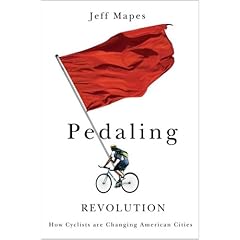
A Book Review by Rick Price, Ph.D.
(by Jeff Mapes, Oregon State University Press, 2009)
The author of Pedaling Revolution, Jeff Mapes, covers politics for the Portland Oregonian;, he is a blogger, a bicycle commuter, and by virtue of having spent nights and weekends from 2004 until April of 2008 thinking about and writing this book, he has become a bicycle advocate. Put him on your list of people to invite to your bike summit or alternative energy fair as recently Mapes was the keynote speaker at such disparate events as the
 energy - SolWestFair - in John Day, Oregon and the Miami Valley Cyclists’ Summit in Dayton, Ohio. (Oh yeah, did I mention, that Mapes’ family just purchased a cargo bike with the capacity to haul 400 lbs of cargo? Now that’s the sign of a committed bicycle advocate.)
So what makes Pedaling Revolution a great book? And what makes Jeff Mapes the latest candidate as spokesperson for our very own bicycle “revolution”? Stories, that’s what, the stock-in-trade of the “literary journalist.”
Mapes is no John McPhee or Tracy Kidder just yet, but he has pulled together a great collection of interviews, stories, and accounts of personal encounters with the people who have made this revolution. And in so doing he reminds us of the value of personal passion, local advocacy, and the role that we all might aspire to play in the revolution. I especially like the nuggets of history and advocacy that he has dredged up in his quest to understand the resurgence of the bicycle in this country.
Take Davis, CA, for example. Why is Davis, widely known as “bike town USA,” head and shoulders above the rest of us for its bike culture? In part, explains Mapes, because of the seeds sown by Davis’s University Chancellor Emil Mrak in the early 1960s. Mrak loved to bicycle and when he became Chancellor he asked his planners and architects to “plan for a bicycle-riding, tree-lined campus.” Then he banned motor vehicles from the central part of campus. The rest is history.
There are other hints of how one person can effect change and help sow the seeds of a bicycle revolution. For example, where did all those bike paths in our bicycle friendly cities come from anyway? Well, you may remember New York Senator Daniel Patrick Moynihan. He was a sociology professor and as a young academic Moynihan wrote an article in 1960 called “New Roads and Urban Chaos,” in which he predicted that urban chaos will break out if States were allowed to build the Interstate Highway system with unrestricted funding from the federal government.
Thirty years later, as chair of the Senate Environment and Public Works subcommittee, Moynihan created local metropolitan planning organizations designed to provide a check and balance on every state’s “roads only” Department of Transportation ( you know, the DOTs) and to mandate that these planning agencies fund “transportation enhancements” that included bike paths and other multi-modal facilities. The result of that legislation is a legacy of nearly two decades of funding for bike paths and bicycle and pedestrian coordinators at the State and city level across the country.
From this personal level of stories about key individuals who have influenced bicycling in the US, Mapes expands his narrative to include a series of readable case studies of cities in Europe and the US. He writes about Amsterdam, Copenhagen and Paris, Chicago, San Francisco and Seattle, and he goes into depth on Davis, Portland, and bicycling in New York City.
You can’t write about the bicycle revolution in the US without exploring the roll of Critical Mass (if you aren’t familiar with “critical mass” your primer is here: http://en.wikipedia.org/wiki/Critical_Mass), urban bike messenger culture, and the controversy within the bicycle community itself over the assertion of people like John Forester, that “cyclists fare best when they act and are treated as drivers of vehicles.” Mapes does all of this and he does it well.
After his great introduction to the recent history of bicycling and bicycle advocacy, Mapes wraps up his narrative in three chapters on bicycle safety, health, and “Bringing Kids Back to Bikes.” It is, in short, a call to arms, to get involved and to bring the revolution to your community. What’s holding you back?
Saturday, August 22, 2009
Big News: The Bike Co-op is Moving!
The Bike Co-op would like to announce that we're moving a few short blocks to a new permanent home at 331 N. College Ave! We just signed the lease yesterday (on Friday). Its awesome, there's nearly 9,000 sq ft of space, it's all heated and insulated, there's plenty of storage, workspace, two bathrooms, a retail area, a great parking lot for test rides, plenty of room out back for donations and recycling. You've just got to see it for yourself to believe it.
Come on down today (Saturday 8/22) at 3pm to 331 N. College if you'd like to lend a hand cleaning it up before we start to move in. Please bring any large push brooms and cleaning supplies you might have available. Then at 5pm this evening we'll be moving Ghana bikes from Steele's market over to the new space. We have a 16' trailer to move them but could use more hands on both ends to speed the process.
Please also plan on joining us tomorrow Sunday 8/23 for a work day (closed to the public) during our normal shop hours Noon-6pm for a work day at 222 Laporte getting things organized for our big move! We will not re-open the shop until everything is moved over to 331 N. College, so please watch for more emails in the upcoming weeks announcing further work/move days.
We will not re-open the shop until everything is moved over to 331 N. College, so please watch for more emails in the upcoming weeks announcing further work/move days.
If you would like to contribute financially, we sure could use some funds to help us offset the costs of repairing/renovating a few areas of our new home, keeping our tools and parts well stocked, and helping out with monthly rent. You can donate via Paypal by credit card, bank account, or Paypal account and all donations are tax decuctible. Please visit our website http://fcbikecoop.org/programs/grants/donations.php and consider a one time or subscription donation. Thank you in advance!
Grinning from ear to ear,
Your Friends at the Fort Collins Bike Co-op
http://fcbikecoop.org/programs/grants/donations.php soon 331 N. College!
Volunteer Opportunities
Come on down today (Saturday 8/22) at 3pm to 331 N. College if you'd like to lend a hand cleaning it up before we start to move in. Please bring any large push brooms and cleaning supplies you might have available. Then at 5pm this evening we'll be moving Ghana bikes from Steele's market over to the new space. We have a 16' trailer to move them but could use more hands on both ends to speed the process.
Please also plan on joining us tomorrow Sunday 8/23 for a work day (closed to the public) during our normal shop hours Noon-6pm for a work day at 222 Laporte getting things organized for our big move! We will not re-open the shop until everything is moved over to 331 N. College, so please watch for more emails in the upcoming weeks announcing further work/move days.
We will not re-open the shop until everything is moved over to 331 N. College, so please watch for more emails in the upcoming weeks announcing further work/move days.
Donations
If you would like to contribute financially, we sure could use some funds to help us offset the costs of repairing/renovating a few areas of our new home, keeping our tools and parts well stocked, and helping out with monthly rent. You can donate via Paypal by credit card, bank account, or Paypal account and all donations are tax decuctible. Please visit our website http://fcbikecoop.org/programs/grants/donations.php and consider a one time or subscription donation. Thank you in advance!
Grinning from ear to ear,
Your Friends at the Fort Collins Bike Co-op
http://fcbikecoop.org/programs/grants/donations.php soon 331 N. College!
Monday, August 17, 2009
Bike Co-op Offers Valet Bike Parking Services
Thomas Edwards is the volunteer at the Fort Collins Bike Co-op who heads up the Valet Bike Parking project. Thomas works with two board members to coordinate and organize our valet parking events but above all he hauls bike racks on our cargo trike and trailer, staffs the parking events, and coordinates volunteers. 

The photo of the trike and loaded trailer was taken during a time trial race on CSU's oval while the other two were taken at New West Fest, 2009. Bicycles left over at the end of an event are hauled back to the Bike Co-op and logged in as abandoned (see photo). The owners can pick them up by calling the Co-op and stopping in during open hours. Note Thomas holding the bolt-cutters that the Co-op volunteers use to cut the locks on bikes that abandoned at the end of an event


The photo of the trike and loaded trailer was taken during a time trial race on CSU's oval while the other two were taken at New West Fest, 2009. Bicycles left over at the end of an event are hauled back to the Bike Co-op and logged in as abandoned (see photo). The owners can pick them up by calling the Co-op and stopping in during open hours. Note Thomas holding the bolt-cutters that the Co-op volunteers use to cut the locks on bikes that abandoned at the end of an event

Subscribe to:
Posts (Atom)